

1. Introduction
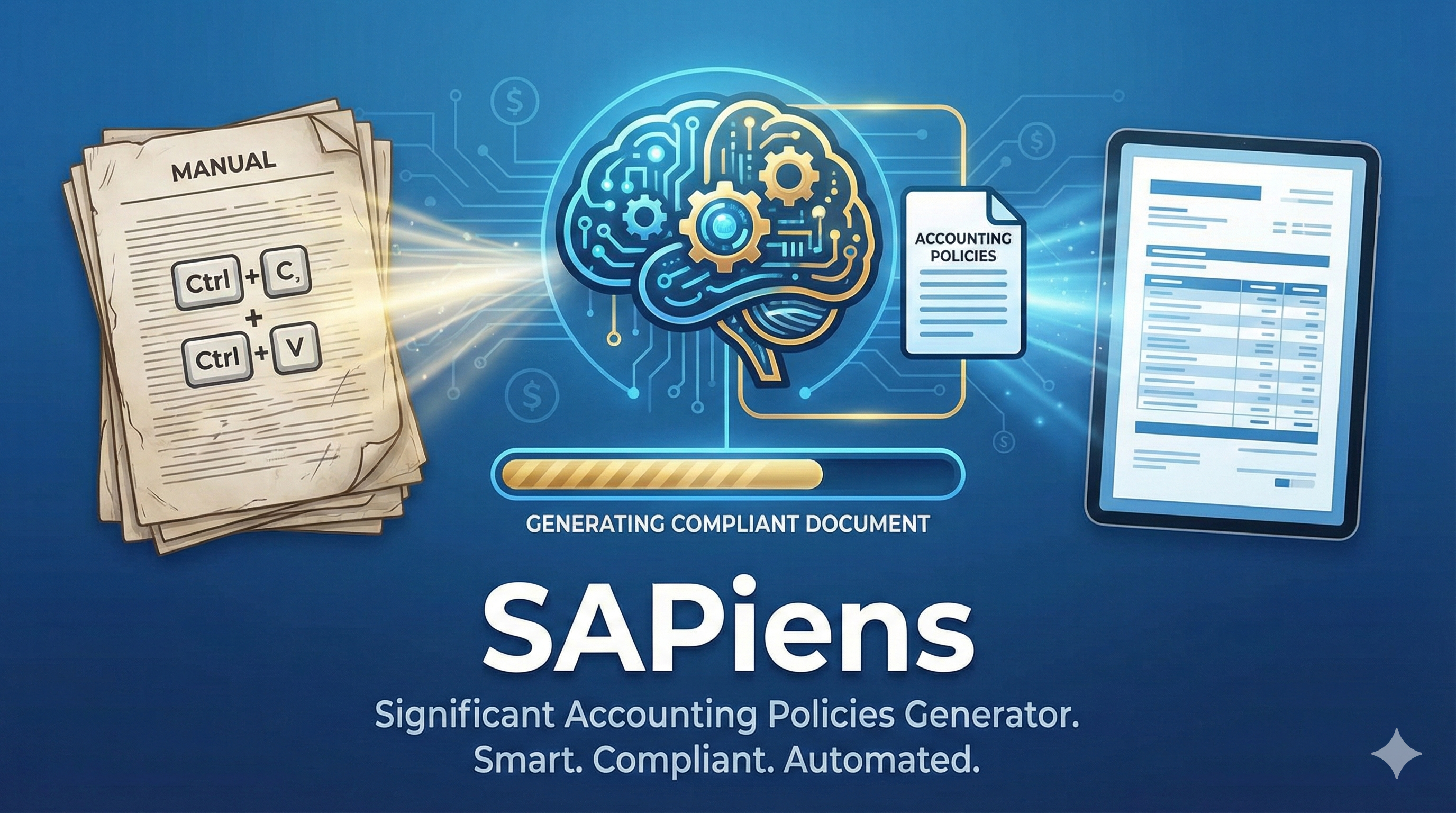
SAPiens is an automated document generation tool specifically designed to draft the "Significant Accounting Policies" note, which is a mandatory and critical component of any audited financial statement.
Every company, from small startups to large conglomerates, must disclose the accounting methods they used (e.g., depreciation methods, revenue recognition rules, valuation of inventory) in their annual reports. Currently, this is often done by "copy-pasting" from previous years or similar companies, leading to errors, outdated references, and non-compliance. SAPiens uses a logic-based questionnaire to generate a perfectly tailored, compliant policy document in minutes.
2. Problem Statement
The drafting of accounting policies faces several systemic issues:
- "Salad-Bowl" Errors: Auditors often copy policies from one client to another, resulting in irrelevant clauses (e.g., a software company accidentally having a policy for "biological assets" like cattle).
- Regulatory Lag: When accounting standards change (e.g., the shift from old lease standards to Ind AS 116 / IFRS 16), manual templates often fail to update, leading to non-compliance.
- Inconsistency: Large groups with multiple subsidiaries often fail to maintain consistent policy wording across all entities.
- Time Consumption: Manually tailoring 20+ pages of technical legal text takes hours of valuable billable time.
3. Objectives
The goal is to build a "TurboTax for Accounting Policies."
- Wizard-Based Generation: To replace manual writing with a "Yes/No" questionnaire (e.g., "Do you hold inventory?" -> If Yes, "Do you use FIFO or Weighted Average?").
- Standardization: To ensure all generated text adheres strictly to the latest International Financial Reporting Standards (IFRS), US GAAP, or Indian Accounting Standards (Ind AS).
- Dynamic Updates: To maintain a central library of clauses that are updated whenever a new accounting standard is issued.
- Multi-Format Export: To export the final policy note directly into Word or PDF, ready for the annual report.
4. Technology Used
The system relies on a logic engine and text assembly tools.
Frontend
- React.js: For a smooth, wizard-style multi-step form interface.
- Redux: To manage the state of the user's answers as they move through different sections (Assets, Revenue, Liabilities).
Backend
- Python (Django/Flask): Python is excellent for text manipulation.
- Jinja2 Templates: To create dynamic text blocks where variables (like depreciation rates or currency symbols) can be inserted automatically.
- DocxTemplate / Python-docx: Libraries to generate MS Word documents programmatically.
Database
- PostgreSQL: To store the "Master Library" of accounting clauses and user project data.
5. Methodology
The application functions as a Decision Tree.
- Clause Library Creation: A database is populated with pre-vetted legal text for every possible accounting scenario (e.g., Revenue from Services, Revenue from Goods, Government Grants).
- The Questionnaire Engine:
- The user starts a new project.
- The system asks high-level questions: “Does the company have Foreign Currency transactions?”
- If No: The system skips that section entirely.
- If Yes: It drills down—“How are exchange differences treated? Taken to P&L or OCI?”
- Text Assembly: Based on the answers, the backend pulls the specific paragraphs corresponding to the logic.
- Review & Customization: The user sees a draft where they can manually tweak specific numbers (e.g., changing "Useful life of 5 years" to "3 years").
- Final Generation: The document is compiled with proper numbering, headers, and fonts matching the corporate style.
6. Expected Outcomes
- 100% Relevance: The final document contains only policies relevant to the client (no "phantom" policies).
- Compliance Safety: Assurance that the wording used is up-to-date with current laws.
- Efficiency: Reducing the drafting time from ~4 hours to ~15 minutes.
- Standardization: Audit firms can ensure all their clients use the firm-approved standard wording.
7. Conclusion
SAPiens modernizes a tedious but essential part of financial reporting. By moving away from "Ctrl+C, Ctrl+V" and towards a logic-driven generation process, it ensures that financial statements are not just compliant, but also accurate and professional. It allows auditors to focus on high-value analysis rather than word-processing.