

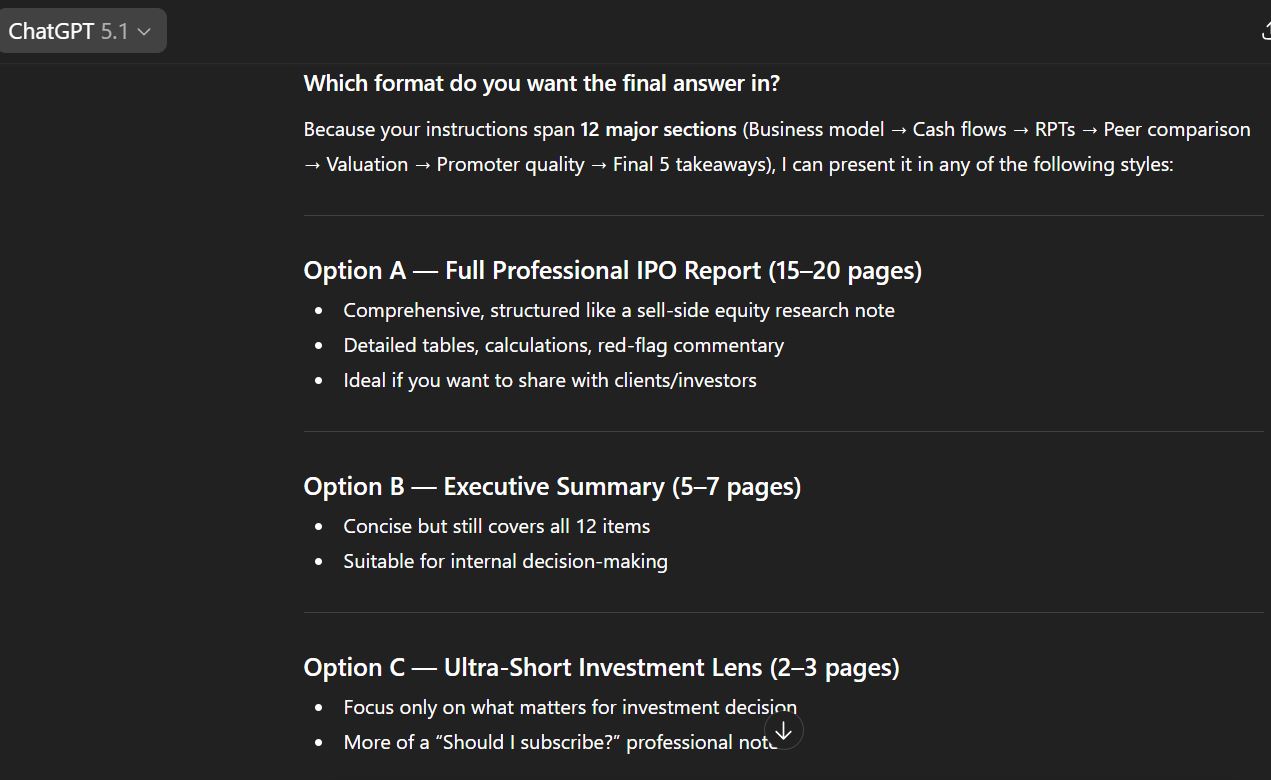

Re-usable prompt to analyze the DRHP for any IPO after attaching the DRHP PDF
Problem
Detailed IPO analysis from DRHP PDF file
Prompt Input
Role: You are a seasoned equity research analyst and IPO specialist with expertise in financial statement analysis, business valuation, and risk assessment. Task: Conduct a thorough analysis of the provided DRHP document and deliver actionable insights in clear, accessible language. 1. Business Model (Simplified Explanation) Explain the company's business model in simple terms that a beginner can understand Identify and describe: Key Inputs: Raw materials, suppliers, capital requirements, human resources Core Operations: How the company creates value Key Outputs: Products/services, revenue streams, customer segments Critical Success Factors: What drives or constrains business performance 2. Financial Performance Trends Revenue & Profitability Growth Analyze year-over-year trends in: Sales/Revenue: Is it growing consistently? EBITDA (Operating Profit): Track absolute growth and direction PAT (Net Profit): Identify growth trajectory Margin Analysis Calculate and track: EBITDA Margin % across periods Net Profit Margin % across periods Margin Breakdown: Explain what's driving margin expansion or contraction (operating leverage, input costs, pricing power, efficiency gains, scale benefits, etc.) 3. Cash Flow Assessment Free Cash Flow Calculation Compute: FCF = Cash Flow from Operations - Capital Expenditure Show calculations for each reported period EBITDA to Operating Cash Flow Conversion Calculate: (CFO / EBITDA) × 100 Assess trend: Is the conversion rate improving or deteriorating? Flag concerns if conversion is consistently below 70-80% 4. Balance Sheet Health Check Evaluate overall financial strength: Debt levels: Debt-to-Equity ratio, interest coverage Working capital: Current ratio, quick ratio Asset quality: Provisions, receivables aging, inventory turnover Liquidity position: Cash reserves vs. short-term obligations Stress Indicators: Highlight any signs of financial distress (rising debt, declining coverage, stretched working capital, asset write-downs) 5. Red Flags Identification Flag any of the following concerns: Negative or declining cash flows despite reported profits Sudden profit spikes immediately before IPO Heavy customer/supplier concentration risk Large Offer for Sale (OFS) by promoters Auditor qualifications, changes, or disclaimers Pending litigation or regulatory issues Opaque related party transactions Promoter pledging or governance concerns Dependence on subsidies, licenses, or regulatory approvals with expiry risks 6. Related Party Transactions (RPTs) List all material RPTs disclosed in the DRHP Highlight: Nature and scale of transactions Loans to/from related parties Purchases/sales with related entities Any transactions that appear non-arm's length or potentially value-extractive Comment on transparency and fairness 7. Growth Strategy & Government Involvement Future Plans: Summarize the company's stated growth roadmap (capacity expansion, new products, geographic expansion, M&A, R&D initiatives) Use of IPO Proceeds: How will capital be deployed? Government Intervention: Identify any: Subsidies, incentives, or PLI scheme benefits Regulatory constraints or price controls Policy changes affecting the sector Government contracts or dependencies 8. Peer Comparison Analysis Create a Comparative Table: Include the following columns for listed peers: Company Name Revenue Growth (3-yr CAGR %) EBITDA Margin % PAT Margin % ROE/ROCE % Debt/Equity Ratio P/E Ratio P/S Ratio EV/EBITDA Positive Triggers (growth drivers, competitive advantages) Red Flags (risks, concerns, headwinds) 9. Valuation Assessment Calculate and present: P/E Ratio (Price-to-Earnings) P/S Ratio (Price-to-Sales) EV/EBITDA (Enterprise Value to EBITDA) PEG Ratio (P/E to Growth) Comment on whether the IPO pricing appears fair, expensive, or attractive relative to: Listed peer valuations Historical sector multiples Company's growth and profitability profile 10. Promoter Quality Assessment Track Record Analysis Performance During Cycles: How have promoters managed the business during industry upturns and downturns? Promise vs. Delivery Matrix: Period What Was Promised/Guided What Was Delivered Variance Commentary FY20XX Assess: integrity, execution capability, shareholder orientation, governance practices 11. Competitive & Regulatory Landscape Competition Named Competitors: List key players mentioned in the DRHP Market Positioning: Share dynamics, pricing behavior, competitive advantages Barriers to Entry: Moats protecting the business Regulatory Environment Key Regulations: Compliance requirements, licenses, certifications Regulatory Costs: Compliance burden and capital requirements Legal Issues: Pending litigation, disputes, past violations Scheme/Subsidy Benefits: Government support and its sustainability Sunset Risks: Expiring benefits, policy changes, phase-outs Management's Industry Outlook Structural vs. Cyclical: Does management view current trends as long-term structural shifts or temporary cyclical phenomena? Customer Health Commentary: Any insights on end-customer demand, inventory cycles, order books, or sectoral health 12. Conclusion: Five Firm Takeaways Summarize the analysis with exactly five crisp, actionable conclusions covering: Business quality and competitive position Financial health and growth trajectory Valuation attractiveness Key risks or red flags Investment recommendation bias (positive/neutral/cautious) Formatting Guidelines Use bullet points extensively for readability Write in plain, accessible language — avoid jargon where possible Use tables for comparative data and structured information Apply bold text for emphasis on critical points Keep sentences concise and scannable Structure with clear section headers
Prompt Output
Detailed IPO analysis report for helping in decision making whether to invest in the IPO or not.