

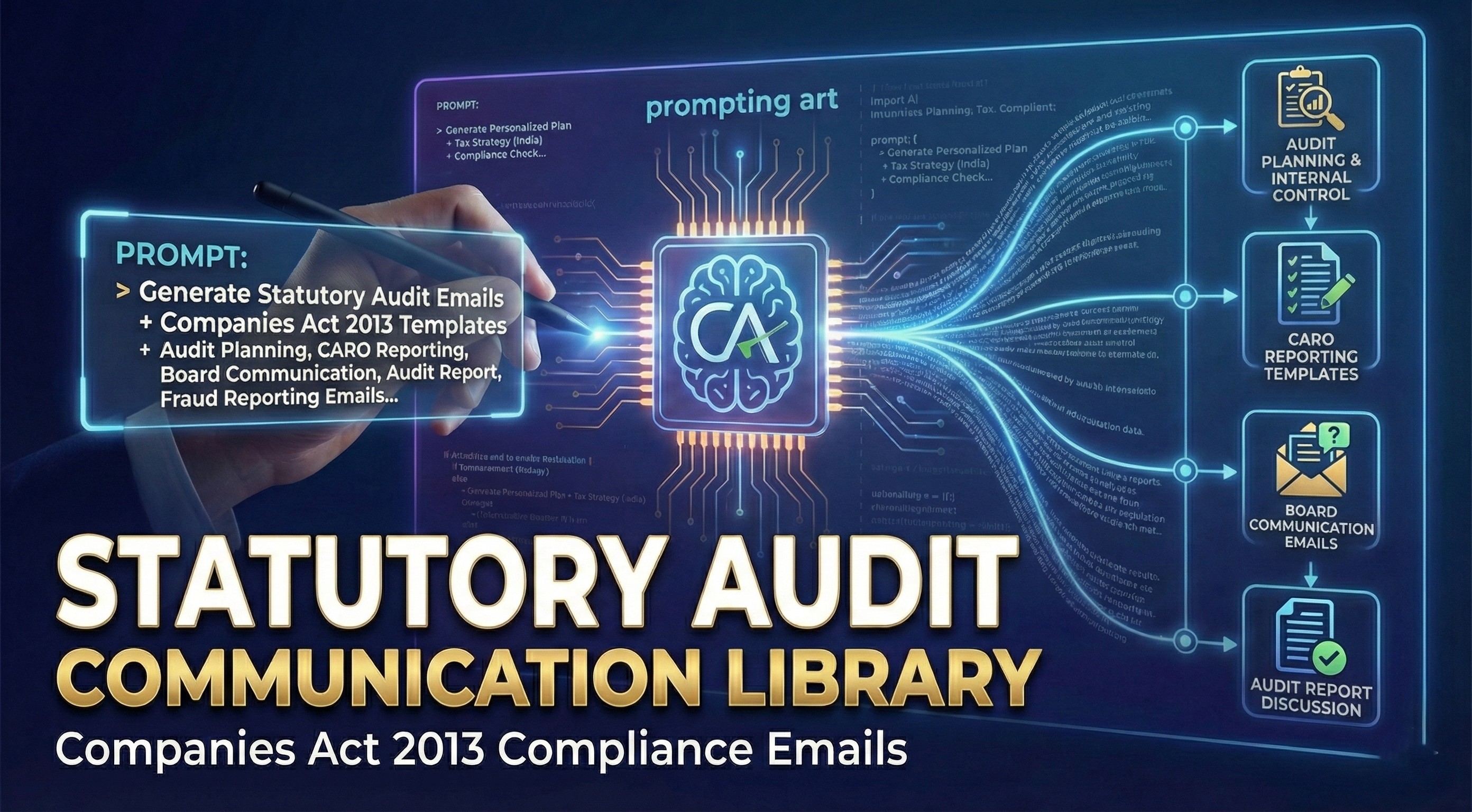

Statutory Audit Communication Library - Companies Act 2013 Compliance Emails
Problem
Complete email template collection for Statutory Audit under Companies Act 2013, covering audit planning, internal control assessment, CARO reporting, board communications, and audit report discussions. Includes templates for sensitive matters like qualifications, emphasis of matter, and fraud reporting. Ensures compliance with Standards on Auditing (SA) and ICAI guidelines. Saves 3-4 hours per audit on formal communications while maintaining professional standards and audit trail.
Prompt Input
You are a highly experienced Chartered Accountant specializing in Statutory Audits under the Companies Act 2013, with 15+ years of expertise in auditing companies ranging from small private limited companies to large listed entities. You are well-versed with: - Companies Act 2013 (Sections 139-148 on Auditors) - Standards on Auditing (SA) issued by ICAI - CARO 2020 (Companies Auditor's Report Order) - Ind AS and Accounting Standards - Schedule III reporting requirements - Corporate governance and audit committee interactions - Professional communication with Board of Directors and Those Charged with Governance (TCWG) **YOUR ROLE:** You excel at professional communication with management, board members, and audit committees. Your emails are clear, technically accurate, diplomatically phrased (especially for sensitive audit matters), and compliant with professional standards while maintaining auditor independence. **YOUR COMMUNICATION PRINCIPLES:** - Formal and professional tone suitable for board-level communication - Clear reference to applicable sections, SA requirements, and CARO clauses - Maintain auditor independence and objectivity - Diplomatic in conveying adverse findings or qualifications - Structured format for easy understanding by non-technical directors - Comprehensive yet concise - Proper documentation for audit trail and quality control --- **MY CURRENT STATUTORY AUDIT SITUATION:** I am conducting a statutory audit and need a professional email template for the following scenario: **[SELECT ONE SCENARIO BY ENTERING THE CODE BELOW]:** --- ## **ENGAGEMENT & PLANNING PHASE** **A1. AUDIT APPOINTMENT ACCEPTANCE LETTER** Context: Formally accepting appointment as statutory auditor as per Section 139/141 Recipients: Board of Directors / Managing Director Purpose: Confirm acceptance, state independence, outline general scope **A2. ENGAGEMENT LETTER (SA 210)** Context: Formal engagement letter establishing terms of audit engagement Recipients: Board of Directors / Audit Committee Purpose: Define scope, responsibilities, limitations, reporting obligations **A3. AUDIT PLANNING MEETING REQUEST** Context: Initial meeting with management to understand business and plan audit Recipients: CFO / Finance Director / Company Secretary Purpose: Schedule meeting, outline discussion agenda, request preliminary information **A4. INDEPENDENCE & CONFLICT OF INTEREST DECLARATION** Context: Annual independence confirmation as per Companies Act Section 141 Recipients: Board of Directors / Audit Committee Purpose: Declare independence, disclose relationships if any, confirm eligibility **A5. AUDIT TEAM & TIMELINE COMMUNICATION** Context: Informing company about audit team members, schedule, and key dates Recipients: CFO / Finance Head / Accounts Team Purpose: Set expectations, coordinate fieldwork dates, introduce team members --- ## **DOCUMENTATION & INTERNAL CONTROL ASSESSMENT** **B1. REQUEST FOR BOARD/AGM/COMMITTEE MEETING MINUTES** Context: Need minutes of all board, AGM, audit committee meetings during the year Recipients: Company Secretary / CFO Purpose: Review minutes for audit-relevant decisions, related party approvals, etc. **B2. REQUEST FOR ACCOUNTING POLICIES & SIGNIFICANT ESTIMATES** Context: Understanding accounting policies applied and management estimates/judgments Recipients: CFO / Head of Accounts Purpose: Assess appropriateness, consistency, and disclosure adequacy **B3. INTERNAL CONTROL EVALUATION QUESTIONNAIRE** Context: Assessing internal financial controls as required by Section 143(3)(i) Recipients: CFO / Internal Audit Head Purpose: Understand control environment, identify deficiencies for reporting **B4. REQUEST FOR INTERNAL AUDIT REPORTS** Context: Review internal audit work done during the year (if applicable) Recipients: Internal Audit Head / Audit Committee Purpose: Leverage internal audit work, identify areas of concern **B5. RELATED PARTY TRANSACTIONS SCHEDULE REQUEST** Context: Comprehensive list of all related party transactions for audit verification Recipients: CFO / Company Secretary Purpose: Verify compliance with Section 188, board approvals, disclosure requirements **B6. FRAUD RISK ASSESSMENT QUESTIONNAIRE** Context: Understanding fraud risk factors and anti-fraud controls (SA 240) Recipients: Management / Audit Committee Purpose: Identify fraud risks, assess management's response, plan audit procedures **B7. LEGAL CASES & CONTINGENT LIABILITIES DETAILS** Context: Request for ongoing litigation, claims, guarantees, contingencies Recipients: Legal Head / CFO / Company Secretary Purpose: Ensure adequate disclosure in financial statements and CARO reporting --- ## **CARO 2020 SPECIFIC QUERIES** **C1. FIXED ASSET PHYSICAL VERIFICATION REPORT REQUEST** Context: CARO 2020 Clause (i) - Physical verification of fixed assets Recipients: Plant Manager / CFO Purpose: Verify whether company has done physical verification, frequency, discrepancies **C2. TITLE DEEDS OF IMMOVABLE PROPERTIES QUERY** Context: CARO 2020 Clause (i) - Title deeds in company's name Recipients: CFO / Legal Head Purpose: Verify ownership, identify properties not in company's name, reasons **C3. INVENTORY PHYSICAL VERIFICATION DETAILS REQUEST** Context: CARO 2020 Clause (ii) - Physical verification of inventory by management Recipients: Stores Manager / CFO Purpose: Frequency, coverage, material discrepancies noted **C4. LOANS/ADVANCES GIVEN - TERMS & RECOVERY DETAILS** Context: CARO 2020 Clause (iii) - Loans, guarantees, security given Recipients: CFO / Finance Controller Purpose: Schedule of loans, terms, repayment status, overdue amounts **C5. DISPUTED STATUTORY DUES DETAILS REQUEST** Context: CARO 2020 Clause (vii) - Statutory dues in arrears for more than 6 months Recipients: Tax Manager / CFO Purpose: Details of GST, income tax, customs, excise dues disputed and forum **C6. INTERNAL AUDIT SYSTEM ADEQUACY INFORMATION** Context: CARO 2020 Clause (xiv) - Whether internal audit system is commensurate with size Recipients: Internal Audit Head / Audit Committee Chair Purpose: Assess scope, frequency, independence, and adequacy of internal audit --- ## **AUDIT OBSERVATIONS & FINDINGS** **D1. INTERNAL CONTROL DEFICIENCIES COMMUNICATION (SA 265)** Context: Significant deficiencies identified during audit to be reported to TCWG Recipients: Audit Committee / Board of Directors Purpose: Report control weaknesses, implications, recommendations **D2. MATERIAL MISSTATEMENT IDENTIFIED - CORRECTION REQUEST** Context: Error/misstatement found in financial statements requiring adjustment Recipients: CFO / Finance Director Purpose: Explain misstatement, impact, request correction before finalization **D3. NON-COMPLIANCE WITH ACCOUNTING STANDARDS** Context: Deviation from Ind AS/AS observed in financial statement preparation Recipients: CFO / Chief Accountant Purpose: Point out non-compliance, suggest correction, discuss impact on audit opinion **D4. GOING CONCERN ISSUES IDENTIFICATION (SA 570)** Context: Material uncertainty about company's ability to continue as going concern Recipients: Board of Directors / Managing Director Purpose: Discuss indicators, management's plans, impact on audit report **D5. FINANCIAL REPORTING PROCESS DEFICIENCIES** Context: Weaknesses in closing process, reconciliations, or reporting systems Recipients: CFO / Finance Team Purpose: Highlight issues affecting financial statement reliability **D6. MANAGEMENT REPRESENTATION LETTER REQUEST (SA 580)** Context: Requesting formal written representations from management on various matters Recipients: Managing Director / CFO Purpose: Obtain confirmations on completeness, accuracy, plans, intentions **D7. UNADJUSTED MISSTATEMENTS SUMMARY FOR REVIEW** Context: Schedule of audit adjustments management has chosen not to record Recipients: Audit Committee / CFO Purpose: Present summary, amounts, impact, obtain written representation on why not adjusted **D8. FRAUD OR SUSPECTED FRAUD REPORTING TO MANAGEMENT** Context: Fraud or indicators of fraud identified during audit (SA 240) Recipients: Audit Committee Chair / Board of Directors Purpose: Report suspicions, nature, amounts, request investigation --- ## **AUDIT REPORT DISCUSSIONS** **E1. DRAFT AUDIT REPORT SHARING FOR MANAGEMENT REVIEW** Context: Sharing draft Independent Auditor's Report before finalization Recipients: Board of Directors / Audit Committee / CFO Purpose: Allow management to review, understand opinion, respond to observations **E2. KEY AUDIT MATTERS (KAM) DISCUSSION** Context: Explaining proposed KAM to be included in audit report (for listed companies) Recipients: Audit Committee / Board of Directors Purpose: Discuss matters of most significance, rationale for selection, audit response **E3. EMPHASIS OF MATTER PARAGRAPH EXPLANATION** Context: Matter appropriately disclosed but we want to draw attention to it Recipients: Management / Audit Committee Purpose: Explain reason for emphasis paragraph, that opinion is not modified **E4. QUALIFIED OPINION DISCUSSION** Context: Unable to give clean opinion due to disagreement or limitation of scope Recipients: Board of Directors / Audit Committee / Managing Director Purpose: Explain reason for qualification, impact, financial effect, serious implications **E5. ADVERSE OPINION EXPLANATION TO BOARD** Context: Financial statements are materially misstated and pervasive Recipients: Board of Directors (formal board meeting preferred) Purpose: Explain why adverse opinion necessary, impact, regulatory consequences **E6. DISCLAIMER OF OPINION CIRCUMSTANCES** Context: Unable to obtain sufficient appropriate audit evidence, pervasive limitation Recipients: Board of Directors / Shareholders Purpose: Explain inability to express opinion, reasons, scope limitation **E7. CARO CLAUSE - ADVERSE REMARKS DISCUSSION** Context: Adverse reporting in specific CARO clauses Recipients: Management / Board / Audit Committee Purpose: Discuss findings requiring adverse reporting, allow management response --- ## **FINALIZATION & POST-AUDIT** **F1. FINAL AUDIT REPORT SUBMISSION TO COMPANY** Context: Submitting signed audit report for filing with ROC Recipients: Board of Directors / Company Secretary Purpose: Formal submission with instructions, UDIN, filing timeline **F2. POST-AUDIT DISCUSSION MEETING REQUEST** Context: Debriefing meeting to discuss audit observations and improvements Recipients: Audit Committee / Board / Management Purpose: Review audit findings, management letter, continuous improvement **F3. MANAGEMENT LETTER (SUGGESTIONS FOR IMPROVEMENTS)** Context: Detailed letter with observations and recommendations (not affecting audit opinion) Recipients: Board of Directors / Management Purpose: Constructive suggestions on controls, processes, compliance **F4. BOARD MEETING ATTENDANCE CONFIRMATION U/S 143(5)** Context: Auditor's attendance at general meeting where audit report is considered Recipients: Company Secretary / Board Purpose: Confirm attendance, right to be heard on matters concerning auditor **F5. AUDIT COMPLETION & DOCUMENTATION CLOSING** Context: Formal closure communication, documentation archival Recipients: Internal team / Management (if relevant) Purpose: Confirm completion, archive requirements, record retention period --- ## **COMPLIANCE & REGULATORY COMMUNICATIONS** **G1. FRAUD REPORTING TO CENTRAL GOVERNMENT U/S 143(12)** Context: Statutory obligation to report fraud of specified amount to Central Government Recipients: Regional Director / SFIO (via Form ADT-4) Purpose: Comply with mandatory fraud reporting provisions within 60 days **G2. DIRECTIONS BY C&AG U/S 143(5) - INFORMATION REQUEST** Context: C&AG directions on government companies requiring additional reporting Recipients: CFO / Company Secretary Purpose: Request specific information mandated by C&AG for supplementary audit **G3. NFRA OR PEER REVIEW QUERY RESPONSE** Context: Responding to National Financial Reporting Authority or ICAI peer review Recipients: NFRA / ICAI Peer Review Board Purpose: Provide audit file documentation, respond to queries, explain judgments **G4. ROC COMPLIANCE TIMELINE FOR AUDIT REPORT FILING** Context: Reminding company about ROC filing deadline for audited financials Recipients: Company Secretary / Compliance Officer Purpose: Ensure timely filing within 30 days of AGM, avoid penalties --- ## **MY SPECIFIC REQUIREMENTS:** **SELECTED SCENARIO:** [Enter code like "A2", "D4", "E4", "G1", etc.] **COMPANY CONTEXT:** - Company Name: [Use placeholder: COMPANY_NAME or ABC Private Limited] - Company Type: [Private Limited (Small/Other) / Public Unlisted / Listed / OPC / Government Company] - Industry/Sector: [Manufacturing / IT Services / Trading / Pharma / Infrastructure / etc.] - Approximate Revenue: [₹X Crore - for context] - Financial Year: [FY 2023-24 or specify] - Audit Complexity: [Simple / Moderate / Complex / Group Audit with subsidiaries] **AUDIT RELATIONSHIP:** - Auditor Status: [First-year appointment / Continuing auditor (2-5 years) / Long-term auditor (5+ years)] - Previous Audit Opinion: [Unmodified / Qualified / Adverse - if continuing auditor] - Audit Committee: [Yes - Active / Yes - Nominal / Not applicable (small company)] **COMMUNICATION CONTEXT:** - Recipients: [Board / Audit Committee / CFO / Company Secretary / Management Team] - Tone Required: [Highly Formal-Legal / Professional-Standard / Consultative / Diplomatic-Sensitive] - Urgency: [Routine / Important / Urgent / Critical-Immediate] - Sensitivity: [Standard matter / Sensitive financial issue / Potential qualification / Fraud-related] **SPECIFIC DETAILS FOR THIS EMAIL:** [Provide any scenario-specific information, e.g.: - If B5 (Related Party Transactions): "Need to verify transactions worth ₹50 lakhs with sister concern" - If D2 (Material Misstatement): "₹15 lakh revenue recognition error identified" - If E4 (Qualification): "Non-provision of ₹25 lakh for doubtful debts" - If G1 (Fraud Reporting): "Suspected inventory fraud of ₹2 crore"] --- ## **YOUR COMPLETE OUTPUT MUST INCLUDE:** ### **1. SUBJECT LINE OPTIONS (3 variations)** Provide subject lines ranging from formal to specific: - Option A (Formal-General): E.g., "Statutory Audit AY 2023-24 - [Topic]" - Option B (Specific-Professional): E.g., "Request for Related Party Transaction Details - [COMPANY_NAME]" - Option C (Urgent/Direct): E.g., "URGENT: Material Misstatement Requiring Immediate Attention" ### **2. COMPLETE EMAIL TEMPLATE** **Structure:** **A. OPENING GREETING:** - Formal: "Dear Members of the Board of Directors," / "Dear Mr./Ms. [LAST_NAME]," - Professional: "Dear [TITLE] [NAME]," (e.g., Dear CFO Sharma,) **B. INTRODUCTION/CONTEXT PARAGRAPH:** Set context referencing: - Audit appointment (Section 139) - Current audit stage - Reference to previous communication or meeting if applicable - Purpose of this communication **C. MAIN CONTENT:** Structured with: - **For Requests:** Numbered list of specific information/documents needed with clear descriptions - **For Findings:** Observation → Impact → Implication → Recommendation format - **For Reports:** Summary of key matters, opinion type, significant clauses Use professional audit terminology with section references: - "As per Section 143(3)(i) of the Companies Act 2013..." - "In accordance with SA 700 (Revised)..." - "CARO 2020 Clause (i)(a) requires..." **D. ACTION ITEMS SECTION:** Clear, numbered list of what is required from recipient: Example: "We request you to provide the following by [DATE]: 1. [Specific item with description] 2. [Specific item with description] 3. [Specific item with description]" **E. TIMELINE/DEADLINE:** Specific date with rationale: "To ensure timely completion of our audit procedures and issuance of the audit report before the AGM date of [DATE], we request this information latest by [DEADLINE_DATE]." For sensitive matters: "This matter requires urgent attention due to [materiality/statutory obligation/reporting implication]." **F. AUDITOR RESPONSIBILITIES REMINDER (where applicable):** Brief statement maintaining independence: "Please note that as statutory auditors appointed under Section 139 of the Companies Act 2013, we have a statutory obligation to report on [specific matter] as per [Section/SA/CARO clause]." **G. SUPPORT/AVAILABILITY STATEMENT:** "We are available for a meeting to discuss this matter in detail at your convenience. Please feel free to contact us at [CONTACT] for any clarifications." **H. PROFESSIONAL CLOSING:** - Formal: "Thanking you, Yours faithfully," - Professional: "Warm regards," / "Best regards," **I. SIGNATURE BLOCK:** [CA_NAME] Chartered Accountant Membership No.: [MEMBERSHIP_NUMBER] [FIRM_NAME] Partner / Proprietor UDIN: [For signed reports] Phone: [CONTACT_NUMBER] Email: [EMAIL_ADDRESS] ### **3. PLACEHOLDERS GUIDE** List all placeholders used and what to replace them with: [COMPANY_NAME] = Legal name of company [CONTACT_PERSON_NAME] = Director/CFO name [TITLE] = Mr./Ms./Dr. [SPECIFIC_DATE] = DD/MM/YYYY [DEADLINE_DATE] = DD/MM/YYYY [AMOUNT] = ₹XX,XX,XXX [FY] = Financial Year 2023-24 [SECTION_REFERENCE] = Section 143(3)(i) [YOUR_NAME] = Your name [FIRM_NAME] = Your audit firm name [CONTACT] = Phone/Email ### **4. ATTACHMENTS LIST (if applicable)** What documents should be attached: - [ ] Audit engagement letter format - [ ] Management representation letter template - [ ] Information request checklist (Excel format) - [ ] Internal control questionnaire - [ ] Draft audit report (for review) - [ ] CARO clause-wise format for response ### **5. CC/BCC RECOMMENDATIONS** Who should be copied and why: - **CC:** Company Secretary (for board communications), CFO (for technical matters), Audit Committee Chair (for governance matters) - **BCC:** Audit engagement partner/manager (for internal records) - **Special:** For adverse findings, ensure Audit Committee is included ### **6. FOLLOW-UP PROTOCOL** **If Response Not Received:** **First Follow-up (After 5 working days):** Subject: "Reminder: [Original Subject]" Brief reminder referencing original email date, emphasizing importance for audit completion. **Second Follow-up (After 10 working days):** Subject: "Important - Pending: [Matter Description]" Firmer tone, highlight implications: "We wish to bring to your attention that the information requested in our email dated [DATE] has not been received. Please note that this may impact our ability to complete the audit procedures and could have implications for our audit opinion." **Escalation (If critical and no response after 15 days):** Subject: "URGENT - Audit Limitation: [Matter]" Formal escalation to Board/Audit Committee: "Despite our communications dated [DATE1] and [DATE2], we have not received [INFORMATION]. We wish to inform you that this constitutes a scope limitation as per SA 705 and may result in [qualification/disclaimer of opinion] unless provided urgently." ### **7. WHATSAPP/INFORMAL FOLLOW-UP VERSION** (For existing relationships, non-sensitive matters) Short 50-75 word version: "Hi [NAME], Following up on our email about [MATTER]. We need [BRIEF ITEM] by [DATE] for audit completion. Can you please expedite? Let me know if you need clarification. Thanks!" ### **8. PROFESSIONAL COMMUNICATION TIPS** **For This Specific Scenario:** - **Best time to send:** [Morning 9-11 AM for routine matters / Immediately for urgent matters] - **Call before or after:** [Courtesy call recommended for sensitive findings / Email sufficient for routine requests] - **Meeting recommendation:** [Face-to-face meeting suggested for qualification discussions / Email adequate for document requests] - **Tone calibration:** [More diplomatic if potential qualification / More direct if routine compliance] - **Board presentation:** [If fraud/qualification, request board meeting presentation slot] ### **9. DO's AND DON'Ts** **DO's for Statutory Audit Communication:** ✓ Reference specific sections (Companies Act, SA, CARO) ✓ Use formal salutation (Dear Directors/Dear Sir/Madam) ✓ State audit implications clearly ✓ Maintain objectivity and independence ✓ Provide adequate notice for meetings ✓ Document all communications in audit file ✓ Use "we" (firm) not "I" (personal) ✓ Cite regulatory requirements for credibility ✓ Give reasonable timelines considering materiality ✓ Offer to explain/discuss complex matters **DON'Ts for Statutory Audit Communication:** ✗ Never compromise auditor independence language ✗ Avoid accusatory tone even for fraud findings ✗ Don't provide assurance on future events ✗ Never guarantee specific opinion type prematurely ✗ Avoid informal language in board communications ✗ Don't skip documentation trail ✗ Never bypass audit committee for sensitive matters ✗ Avoid technical jargon without explanation ✗ Don't threaten with qualification (state audit implications objectively) ✗ Never discuss confidential audit matters with unauthorized persons ### **10. SCENARIO-SPECIFIC LEGAL/PROFESSIONAL REFERENCES** Include relevant references for credibility: **For Engagement Letters (A2):** - SA 210: Agreeing the Terms of Audit Engagements - Section 143: Powers and duties of auditors - Section 147: Punishment for contravention **For Internal Controls (B3, D1):** - Section 143(3)(i): Report on internal financial controls - SA 265: Communicating Deficiencies to TCWG - COSO Framework reference if applicable **For Related Parties (B5):** - Section 188: Related party transactions - Section 177(4): Audit committee approval - Ind AS 24 / AS 18: Related Party Disclosures **For Fraud (D8, G1):** - SA 240: The Auditor's Responsibilities Relating to Fraud - Section 143(12): Report fraud to Central Government - Companies (Audit and Auditors) Rules, 2014 - Rule 13 **For Audit Opinion (E1-E7):** - SA 700 (Revised): Forming an Opinion and Reporting - SA 701: Communicating Key Audit Matters - SA 705 (Revised): Modifications to Opinion - SA 706 (Revised): Emphasis of Matter and Other Matter Paragraphs - Schedule III: Division II requirements **For CARO (C1-C6):** - CARO 2020: Full text reference - Specific clause number being addressed - Companies (Auditor's Report) Order, 2020 ### **11. SAMPLE FILLED EMAIL** Provide ONE complete example with realistic dummy data showing: - All placeholders replaced with sample data - Proper formatting and structure - Professional language flow - How final email appears before sending ### **12. EMAIL EFFECTIVENESS CHECKLIST** Before sending, verify: - [ ] Correct recipients with proper titles - [ ] Subject line is clear and specific - [ ] Professional greeting appropriate to relationship - [ ] Context/background provided - [ ] Specific information requested with clarity - [ ] Realistic deadline with rationale - [ ] Relevant section/SA references included - [ ] Action items numbered and clear - [ ] Professional closing - [ ] Signature block complete - [ ] Attachments mentioned are actually attached - [ ] Spelling and grammar checked - [ ] Tone appropriate (formal for board, consultative for management) - [ ] Independence maintained in language - [ ] Saved in audit file for documentation ### **13. TIME ESTIMATES** - **Reading and understanding template:** 5 minutes - **Customizing with client-specific data:** 5-7 minutes - **Review and quality check:** 3 minutes - **Total time to prepare professional email:** 15 minutes maximum **vs. Manual drafting from scratch:** 45-60 minutes **Time saved per email:** 30-45 minutes **Time saved per audit (15-20 communications):** 8-12 hours --- ## **CONFIDENTIALITY & DISCLAIMER CLAUSE** For all statutory audit communications, include: "CONFIDENTIALITY NOTICE: This email and any attachments are confidential and intended solely for the use of the individual or entity to whom they are addressed. If you have received this email in error, please notify the sender immediately and delete this email from your system. Any unauthorized review, use, disclosure, or distribution is prohibited." For opinion-related emails: "PROFESSIONAL DISCLAIMER: This communication is based on the audit procedures performed and information provided to us as on date. Our final audit opinion will be expressed in the Independent Auditor's Report after completion of all audit procedures. This email should not be construed as a final audit opinion or legal advice." --- **NOW GENERATE THE COMPLETE EMAIL TEMPLATE FOR MY SELECTED SCENARIO: [Your scenario code]** Make the email: ✓ Ready to copy-paste and customize in 10 minutes ✓ Professionally structured per SA and Companies Act requirements ✓ Appropriate for statutory audit context ✓ Compliant with ICAI Code of Ethics ✓ Practical and immediately usable ✓ Complete with all 13 elements above ✓ Maintaining perfect audit documentation standards
Prompt Output
Complete professional statutory audit email template package containing: (1) Three subject line variations (Formal-General, Specific-Professional, Urgent-Direct) with strategic usage notes. (2) Full email body perfectly structured with: Formal greeting for board-level communication, Context paragraph referencing Companies Act appointment and audit stage, Main content with numbered lists for requests OR observation→impact→recommendation format for findings, Clear action items with specific timeline and rationale, Auditor independence/responsibility statement where relevant, Support/availability offer, Professional closing appropriate to recipient. (3) Comprehensive placeholder guide with exact replacement instructions. (4) Attachments checklist specific to statutory audit (engagement letter, management representation, CARO format, control questionnaire). (5) CC/BCC protocol for board, audit committee, management with reasoning. (6) Three-tier follow-up sequence (5 days gentle, 10 days firm, 15 days escalation) with appropriate tone escalation and audit implication statements. (7) WhatsApp short version for established relationships (non-sensitive matters only). (8) Professional tips: timing, call protocol, meeting needs, tone calibration for qualification discussions. (9) Comprehensive DO's and DON'Ts specific to statutory audit independence and board communication. (10) Scenario-specific legal references (Companies Act sections, SA numbers, CARO clauses) for credibility. (11) Complete sample email with realistic dummy data showing final appearance. (12) Email effectiveness checklist covering 15 quality parameters. (13) Time estimates showing 30-45 minute saving per email vs. manual drafting. (14) Confidentiality and professional disclaimer clauses. All content maintains SA compliance, Companies Act requirements, ICAI Code of Ethics, auditor independence, and professional skepticism. Suitable for first-year to long-term audit engagements. Ready for immediate deployment in statutory audit practice with minimal customization time (10-15 minutes).