

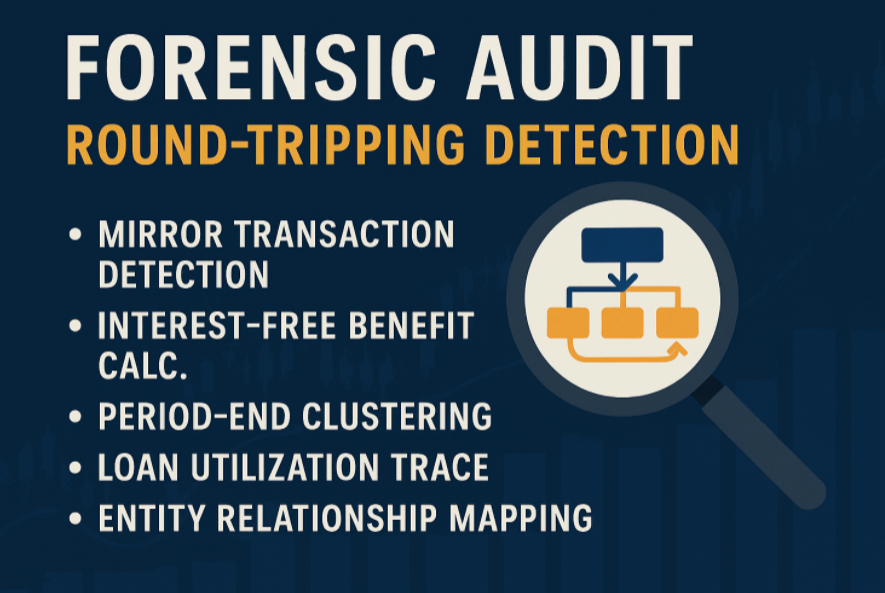

ROUND-TRIP FRAUD DETECTION - BANK STATEMENT ANALYZER
Problem
This prompt system essentially turns AI into your forensic audit assistant that can scan thousands of transactions in minutes, doing work that would take a human team weeks. The key innovation is that it doesn't just look at outstanding balances - it traces fund flows throughout the entire period, which is exactly how round-tripping gets caught.
Prompt Input
You are an expert forensic auditor with 25+ years of experience in detecting fund round-tripping, related-party concealment, and loan diversion fraud. I am uploading bank statements for [COMPANY NAME] for the period [START DATE] to [END DATE] across [NUMBER] bank accounts. Your mission is to perform a DEEP forensic analysis to detect round-tripping of funds - where loan proceeds or company funds are temporarily diverted to directors, relatives, related parties, or connected entities, and returned before period-end to avoid detection. PHASE 1: DATA INGESTION & STRUCTURING 1. Parse ALL uploaded bank statements (PDF/Excel/CSV) 2. Create a unified transaction ledger with these columns: - Date - Bank Account Number / Name - Transaction Type (Credit/Debit) - Amount - Counterparty Name / Narration - Reference Number / UTR / Cheque Number - Running Balance 3. Standardize all counterparty names (e.g., "RAJESH K", "RAJESH KUMAR", "R KUMAR" should be grouped as one entity) 4. Tag each transaction with: - NEFT/RTGS/IMPS/Cheque/Cash/UPI/Internal Transfer - Inward or Outward PHASE 2: ROUND-TRIP DETECTION ENGINE Run the following detection algorithms: **TEST 1 MIRROR TRANSACTION DETECTION** - Find every DEBIT that has a corresponding CREDIT of the same amount (or near-same ±2%) from the same or linked counterparty within the SAME reporting period - Flag pairs where: → Money goes OUT early/mid-period and comes BACK near period-end → Especially 5-15 days before quarter-end / year-end → Amount is round figure (₹5,00,000 / ₹10,00,000 / ₹25,00,000 etc.) **TEST 2 BOOMERANG PATTERN** - Detect chains: Company A → Party B → Party C → Back to Company A - Track funds that leave from one bank account and return to a DIFFERENT bank account of the same company - Identify triangular flows across the uploaded accounts **TEST 3 PERIOD-END CLUSTERING** - Flag ALL credits received in the LAST 7/15/30 days of each quarter-end (March 31, June 30, Sept 30, Dec 31) - Cross-match these credits with debits made earlier in the period - Calculate: What % of total year-end balance is made up of last-week credits? (Red flag if >15-20%) **TEST 4 RECURRING COUNTERPARTY PATTERN** - Identify counterparties that REPEATEDLY receive and return funds in a cyclical pattern - Build a frequency table: | Counterparty | Total Outflows | Total Inflows | Net | Cycles | - Flag any party where NET position is near ZERO across the year (money goes and comes back no genuine business purpose) **TEST 5 LOAN UTILIZATION TRACE** - Identify ALL loan disbursement credits from banks/NBFCs - Track WHERE these exact amounts (or split amounts) went within 3-7 days of disbursement - Flag if loan proceeds went to: → Individuals (not vendors/suppliers) → Companies with similar names to directors → Parties who returned the money later **TEST 6 INTEREST-FREE BENEFIT CALCULATION** - For every flagged round-trip: → Calculate number of days funds were parked outside → Apply SBI lending rate + 2% (or company's actual borrowing rate) → Compute NOTIONAL INTEREST that should have been charged → Total up the "free money benefit" enjoyed **TEST 7 SPLIT TRANSACTION DETECTION (STRUCTURING)** - Detect if a large amount is broken into smaller pieces to avoid detection thresholds - Example: Instead of ₹50 lakh single transfer, five transfers of ₹9.5-10 lakh each on same/consecutive days to same/linked party - Flag transactions just below ₹10 lakh (cash reporting threshold) or just below ₹50 lakh **TEST 8 DORMANT ACCOUNT ACTIVATION** - Identify counterparties who are active ONLY around period-ends - Parties with zero transactions for months, then suddenly large credits near year-end **TEST 9 WEEKEND/HOLIDAY PATTERN** - Flag large transactions on unusual dates: → Last working day before holiday → Saturday NEFT/RTGS transactions → Transactions on days company was supposedly closed **TEST 10 VELOCITY ANALYSIS** - Flag accounts where daily turnover suddenly spikes (normal daily movement ₹5L, but suddenly ₹2Cr moves in a day) - Calculate standard deviation of daily flows and flag anything beyond 2σ PHASE 3: ENTITY RELATIONSHIP MAPPING 1. Build a NETWORK MAP of all unique counterparties 2. Group entities that may be related: - Same/similar names - Same bank account receiving from multiple company accounts - Common words suggesting family (same surname as directors if known) 3. Create a FLOW DIAGRAM showing: - Which parties received maximum funds - Which parties returned funds near period-end - Circular flows PHASE 4: DIRECTOR/RELATED PARTY RED FLAGS Flag transactions to/from parties where narration contains: - Director names: [LIST DIRECTOR NAMES IF KNOWN] - Keywords: "loan", "advance", "personal", "unsecured", "investment", "deposit", "temporary", "accommodation", "current account", "DTA" (Director's Transaction Account) - Any individual names receiving amounts > ₹1,00,000 - Any company whose name contains words from director names PHASE 5: OUTPUT FORMAT Deliver results in this structure: **SECTION A: EXECUTIVE SUMMARY** - Total accounts analyzed - Total transactions analyzed - Number of flagged transactions - Total amount involved in suspected round-tripping - Estimated interest benefit/loss - Risk Rating: LOW / MEDIUM / HIGH / CRITICAL **SECTION B: HIGH-RISK FLAGGED TRANSACTIONS TABLE** | Sr | Date Out | Amount | To Whom | Date In | Amount Back | | Days Parked | Interest Loss | Risk Level | Detection Test # | **SECTION C: COUNTERPARTY RISK RANKING** | Rank | Counterparty | Total Out | Total In | Net | Frequency | | Pattern Type | Risk Score (1-10) | **SECTION D: PERIOD-END ANALYSIS** - Balance build-up analysis for each quarter-end - Genuine vs suspicious credits near period-end **SECTION E: FLOW DIAGRAMS** - Visual representation of fund flows - Circular/triangular patterns highlighted **SECTION F: AUDIT RECOMMENDATIONS** - Specific transactions to verify with management - Documents to demand (board resolutions, loan agreements) - Related party disclosure gaps - Regulatory reporting implications (Section 185/186 of Companies Act, RBI guidelines) - Tax implications (Section 2(22)(e) deemed dividend) PHASE 6: ADDITIONAL INTELLIGENCE CHECKS 1. **Cash Withdrawal Correlation**: Flag if company withdraws cash and a related party deposits cash elsewhere (can't see other account but flag the cash patterns) 2. **Salary Account Anomalies**: If directors are receiving amounts far exceeding their disclosed salary/remuneration 3. **Fixed Deposit Manipulation**: Money moved to FD just before year-end to show as "investment" rather than "loan" 4. **Inter-Bank Transfer Washing**: Moving money between company's own accounts rapidly to create confusion before sending it out 5. **Shell Company Indicators**: Counterparties that only transact in round figures, have no GST-related descriptions, no TDS deductions visible IMPORTANT RULES - Do NOT ignore small transactions fraud is often hidden in small amounts across many accounts - Treat EVERY period-end credit as suspicious until proven otherwise - If two counterparties share the same bank account number but different names - HIGHEST RED FLAG - Assume management is sophisticated - look for 2-3 layer deep routing, not just direct round-trips - Consider that the SAME fraud pattern may use different counterparties each quarter to avoid pattern detection - Flag even if only ONE leg of a suspected round-trip is visible (the return may come from a different entity) Start your analysis now. Ask me clarifying questions if needed before proceeding.
Prompt Output
Tip Detail Use Claude/GPT-4 with file upload These handle large bank statements best Convert PDF to Excel first AI reads structured data more accurately Process one account at a time If hitting token limits, analyze each bank account separately then ask AI to cross-reference Always verify AI output AI flags suspects -YOU confirm with evidence Run the prompt TWICE Different runs may catch different patterns Feed director names separately Tell AI: "Directors are: X, Y, Z. Their known relatives are: A, B, C" for precise matching