From AI Assistant to AI Work Partner
For years, generative AI has primarily been associated with activities such as answering questions, summarising documents, generating text and producing code.
The next stage is considerably more ambitious.
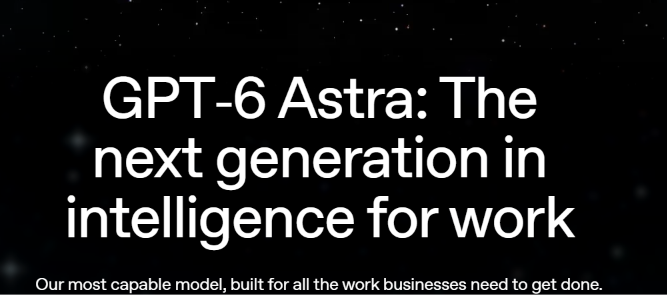
GPT-6 Astra is designed around the idea that an AI system should be able to understand a task and carry out multiple steps required to complete it.
This includes interacting with computers and browsers, working with professional software, analysing information, creating digital artifacts and responding to changes in instructions during an ongoing task.
This represents an important development in the evolution of AI agents and agentic AI.
Instead of simply telling a user how to complete a task, an advanced AI agent can increasingly participate in the task itself.
For example, an AI system could potentially research information, organise the findings, prepare a document, analyse supporting data and make revisions based on additional instructions—all within a connected workflow.
The shift is significant because professional work often involves far more than generating a single answer. It requires reasoning, context management, software interaction, verification and decision-making across multiple steps.
What Makes GPT-6 Astra Different?
GPT-6 Astra combines several areas of AI capability that have traditionally been developed separately.
These include:
- Advanced reasoning
- Computer-use capabilities
- Web and browser interaction
- Software engineering
- Data analysis
- Scientific reasoning
- Professional document creation
- Visual and design understanding
- Multi-step task execution
- Improved instruction following
- Cybersecurity capabilities
- Longer-running agentic workflows
According to OpenAI, Astra is designed to work across code, browsers and professional software while maintaining context throughout complex tasks.
This combination is central to the emerging concept of agentic artificial intelligence—systems that can plan and execute sequences of actions rather than simply producing one response at a time.
AI That Can Use a Computer
One of the most notable areas of GPT-6 Astra's development is computer use.
Traditional AI assistants generally provide instructions that a human must execute. Computer-use models are designed to interact with digital environments themselves.
OpenAI says Astra can perform tasks such as filling online forms, updating records, conducting online research, working with documents and spreadsheets, analysing scientific data, creating websites and testing software interfaces.
This capability could have significant implications for AI automation and digital workflow automation.
Consider a typical business process involving several applications:
- Collect information from a website.
- Organise the information into a spreadsheet.
- Analyse the resulting dataset.
- Prepare a presentation.
- Draft a summary report.
- Review the output for errors.
- Make revisions based on feedback.
Historically, these steps would require a person to move between multiple applications.
The emerging AI-agent approach attempts to connect these activities into a single workflow.
That does not eliminate the need for human oversight. Instead, it changes the role of the human from performing every individual action to setting objectives, providing context, reviewing results and making important decisions.
A Major Step for AI in Professional Work
The workplace may be one of the most important areas affected by this evolution.
GPT-6 Astra has been developed with professional workflows in mind, including documents, presentations, spreadsheets, data analysis and other forms of knowledge work.
OpenAI says Astra has been trained to work more effectively with existing templates, maintain structured narratives and focus outputs on the information relevant to the task rather than unnecessarily repeating context.
This matters because professional productivity is rarely about producing information alone.
A useful business report, for example, requires:
Data → Analysis → Context → Interpretation → Presentation → Review
AI systems that can participate across this entire chain could change how teams approach business intelligence, data analytics, reporting automation and knowledge management.
For analysts and business professionals, the technology could potentially assist with repetitive data preparation while leaving humans to focus more heavily on interpretation and strategic decisions.
AI and Software Engineering Enter a New Phase
Software development is another major area of focus.
OpenAI describes GPT-6 Astra as its strongest model for software engineering to date, with improvements in coding, testing, debugging and longer-running development workflows.
Recent reporting has highlighted benchmark results in areas such as terminal-based software engineering and coding-agent tasks.
An important change is the movement from code generation to software engineering agents.
Writing a function is only one part of software development.
A real software project may require an AI system to:
- Understand an existing codebase
- Identify the source of a bug
- Modify multiple files
- Run tests
- Inspect failures
- Make corrections
- Verify the result
- Continue working after new requirements arrive
This type of workflow requires persistent context and iterative reasoning.
Astra introduces an experimental approach to preserving information across context windows in Codex, allowing earlier requirements, test results and tool outputs to remain searchable during long-running tasks.
The broader trend is clear: AI coding tools are evolving toward autonomous software development workflows rather than simple code autocomplete.
Better Understanding of Context and Human Intent
Another important development is the model's ability to handle ambiguity.
In real-world work, instructions are rarely perfect.
A manager might say:
"Prepare the monthly report using the usual format and highlight anything unusual."
A human professional understands that "usual format" refers to previous reports and that "unusual" requires looking for meaningful deviations.
Advanced AI systems increasingly need to make similar contextual judgments.
According to OpenAI, GPT-6 Astra is designed to use available context to resolve routine ambiguities while asking focused questions when missing information could materially change the outcome.
The model is also designed to incorporate new instructions without abandoning the broader objective.
This capability is particularly relevant to AI productivity tools, where tasks may evolve over hours rather than being completed in a single interaction.
The Rise of AI Agents
The development of GPT-6 Astra comes at a time when the technology industry is increasingly focused on AI agents.
An AI agent can be broadly understood as a system capable of:
Understanding a goal → Planning actions → Using tools → Observing results → Adjusting its approach → Completing the task
This is different from conventional chatbot behaviour.
A chatbot may answer:
"Here is how you can analyse this dataset."
An agentic system may increasingly be capable of:
"I analysed the dataset, identified the relevant trends, created the visualisation and prepared the report."
That distinction could become one of the defining developments in AI technology in 2026.
AI for Data Science and Analytics
The implications extend to data professionals as well.
Modern data workflows frequently involve multiple stages:
- Data extraction
- Data cleaning
- SQL querying
- Statistical analysis
- Visualisation
- Dashboard development
- Report generation
- Quality checking
AI systems capable of interacting with data tools and software could automate portions of this pipeline.
This could accelerate areas such as AI-powered data analytics, business intelligence, automated reporting, data engineering and decision intelligence.
However, human expertise remains important.
A technically correct analysis can still produce a misleading conclusion if the underlying data, assumptions or business context are misunderstood.
Therefore, the likely evolution is not simply "AI replaces analysts." A more immediate development is AI-assisted analytical workflows, where humans provide objectives, context and validation while AI handles increasingly complex operational steps.
Scientific Research and Complex Problem Solving
Scientific reasoning is another area where GPT-6 Astra has attracted attention.
OpenAI reports strong results across mathematical and scientific evaluations, including FrontierMath and other benchmark tests. The company says Astra has also contributed to solving difficult mathematical problems.
Independent reporting has also highlighted the model's performance across mathematics, science and complex computer-based tasks.
The significance goes beyond benchmark numbers.
Scientific research often involves:
Literature → Hypothesis → Data → Experiment → Analysis → Verification → Communication
AI systems that can assist across multiple stages could potentially accelerate research workflows.
The technology may become particularly useful for repetitive computational work, literature analysis, data interpretation and simulation, while researchers remain responsible for scientific judgement and validation.
Cybersecurity: Greater Capability, Greater Responsibility
One of the most important aspects of the GPT-6 Astra launch is cybersecurity.
OpenAI says Astra is its first model to reach the Critical cybersecurity capability level under its Preparedness Framework.
According to the company's safety assessment, the model has capabilities that could potentially allow it to discover previously unknown vulnerabilities and develop sophisticated exploitation techniques under the right conditions.
This creates a difficult technological balance.
The same capabilities that can help cybersecurity professionals discover vulnerabilities can potentially be misused.
As AI becomes more capable, AI safety, AI alignment, cybersecurity safeguards and responsible AI deployment become increasingly important.
OpenAI says Astra has undergone additional safety training, jailbreak testing, monitoring and evaluations designed to reduce harmful or unauthorized behaviour.
The broader lesson is that AI advancement and AI safety must develop together.
The Importance of Human Oversight
Greater autonomy does not mean that human judgement becomes unnecessary.
In fact, as AI systems become capable of performing more actions, human oversight may become even more important.
There is a fundamental difference between asking an AI system to draft a paragraph and allowing it to interact with business systems, modify software or perform actions on a user's behalf.
The consequences of an error can become much larger.
This is why modern AI-agent systems increasingly focus on:
- Permission controls
- Task boundaries
- Monitoring
- Confirmation mechanisms
- Security policies
- Auditability
- Human review
- Responsible deployment
OpenAI reports that GPT-6 Astra has been designed to better respect task boundaries and remain within authorised scopes.
These safeguards will likely become a defining part of the next generation of enterprise AI.
A New Approach to Productivity
The most interesting question may not be whether AI can generate better text or code.
It may be whether AI can help people complete entire projects faster and more effectively.
Imagine a professional starting the day with a complex objective rather than a list of individual tasks.
Instead of manually opening multiple applications, searching for information, preparing files and compiling reports, an AI agent could potentially coordinate many of these steps.
The human could then focus on:
What should be done?
Why does it matter?
What decision should be made?
Is the result accurate?
This represents a transition from task automation to workflow intelligence.
What This Could Mean for the Future of Work
The arrival of increasingly capable AI agents could change the way many professions operate.
For Business Professionals
AI could assist with research, reports, presentations, correspondence, spreadsheets and routine administrative workflows.
For Data Analysts
AI could increasingly support data preparation, SQL, visualisation, statistical analysis and automated reporting.
For Software Developers
AI agents could assist with coding, debugging, testing, documentation and software maintenance.
For Researchers
AI could help analyse large amounts of information, perform computational tasks and support scientific workflows.
For Designers and Creators
AI could increasingly combine visual reasoning with software interaction to create and refine digital experiences.
For Organisations
The larger opportunity could be the integration of AI into end-to-end workflows rather than using isolated AI tools for individual tasks.
The Broader AI Industry Is Moving Toward Agentic Systems
GPT-6 Astra is part of a much larger industry trend.
Across the AI sector, research is increasingly focused on models that can reason over longer tasks, use external tools, operate computers and maintain context.
The competitive frontier is therefore moving beyond traditional measures such as:
"How good is the model at answering questions?"
toward questions such as:
"How reliably can the model complete a real-world task?"
This shift is helping define the emerging category of agentic AI, where reasoning, tool use, memory, computer interaction and autonomous execution become interconnected.
The Road Ahead
GPT-6 Astra represents an important step in the evolution of artificial intelligence from conversational systems toward more capable AI work agents.
Its significance is not limited to another increase in benchmark performance.
The bigger development is the combination of:
Reasoning + Computer Use + Coding + Research + Data + Professional Work + Safety
into a single AI system.
As these technologies continue to develop, the distinction between an AI that "answers" and an AI that "acts" may become increasingly important.
The coming years could see AI systems become more deeply integrated into software, business processes, scientific research and everyday digital work.
However, capability alone will not determine the long-term impact of these systems. Reliability, transparency, security, privacy and human oversight will be equally important.
The next generation of artificial intelligence is therefore not simply about creating smarter chatbots.
It is about building systems that can understand objectives, work across digital environments, reason through complexity and help transform ideas into completed work.
And that could mark one of the most significant transitions in the history of workplace technology.
Source:openaiGPT.