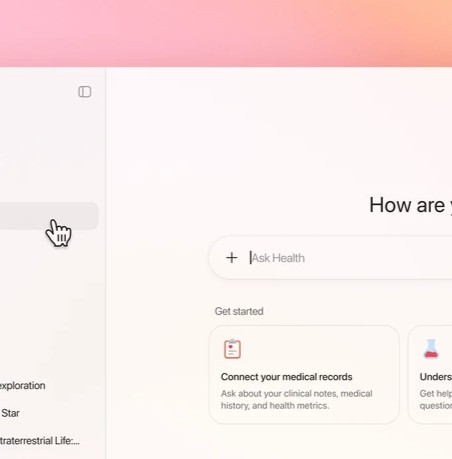
. What Is ChatGPT Health? A New Era of AI-Enabled Personal Health Assistance
OpenAI’s ChatGPT Health is the company’s newest health-focused feature integrated within the popular ChatGPT platform. Positioned as a health and wellness query space, ChatGPT Health allows users to securely connect and organize disparate health data — such as medical records, fitness metrics, and nutrition logs — so AI responses can be contextually grounded in the individual’s personal data.
The launch comes in response to soaring demand for health-related information worldwide, with hundreds of millions of users already turning to ChatGPT for health and wellness questions each week.
2. Personalized Data Integration: Medical Records + Fitness Apps
A key capability of ChatGPT Health is that it integrates with various health data sources:
- Electronic medical records — initially available only in the U.S.
- Fitness and wellness apps like Apple Health, MyFitnessPal, Peloton, Weight Watchers, Function and more.
- Lifestyle data including activity patterns, sleep metrics, and nutrition logs.
Through partnerships with digital health platforms, OpenAI enables users to pull information previously scattered across portals and devices into one interactive AI-assisted environment.
3. How It Works: AI-Driven Health Insights With Privacy Controls
When users choose to link data, ChatGPT Health utilizes advanced AI reasoning and personalized context to help with tasks such as:
- Interpreting lab results
- Explaining medical reports and visit summaries
- Advising on diet, fitness and wellness goals
- Preparing users for doctor visits
However, OpenAI has been careful to clarify that ChatGPT Health does not diagnose illness, prescribe treatment, or replace clinicians.
To protect sensitive information, ChatGPT Health operates in an isolated environment with enhanced privacy safeguards:
- Separate chat history and memory for health queries
- Health data is not used to train OpenAI’s core AI models by default
- Users can disconnect data sources at any time
- Enhanced encryption and security measures are applied to protect personal data
4. Safety & Limitations: Not a Substitute for Medical Care
Despite advanced personalization features, OpenAI underscores that ChatGPT Health is not a clinical diagnostic or treatment tool and should not be interpreted as professional health advice. This distinction aims to manage expectations and prevent misuse of AI for high-stakes medical decisions.
The company’s guidance aligns with broader industry caution about using AI for health decisions without professional oversight, as documented in medical safety research highlighting limitations of AI responses to patient questions.
5. Rollout, Availability & Future Outlook
ChatGPT Health is initially rolling out to a selected group of users on free and paid ChatGPT plans, with a waitlist required for access. Wider availability on web and iOS platforms is expected in the coming weeks.
OpenAI’s launch signals a broader trend in artificial intelligence — one where AI is augmenting personal health engagement and data interpretation without replacing human clinicians. As policy frameworks evolve, tools like ChatGPT Health could reshape how individuals prepare for medical consultations and manage wellness routines.
Source: businessGPT.