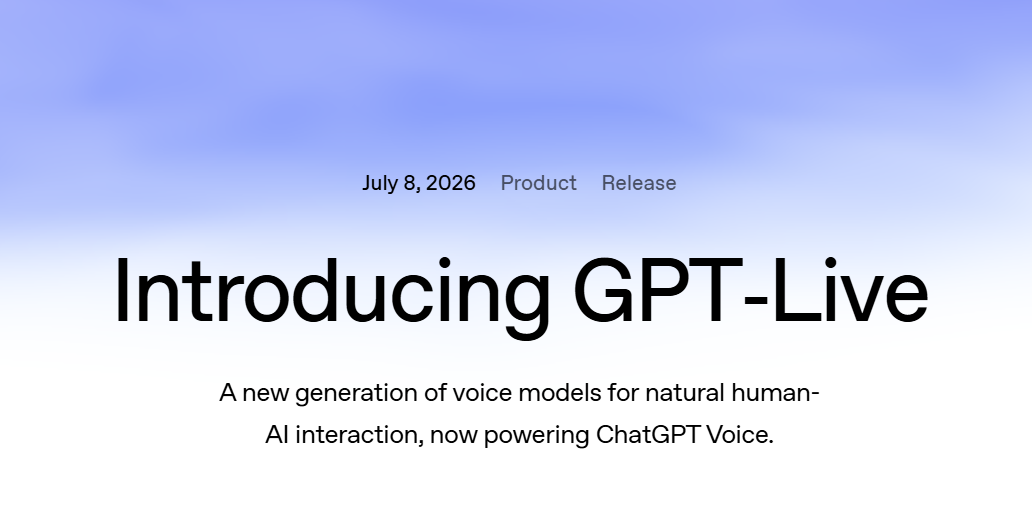
GPT-Live: Making AI Conversations Feel Truly Human
The Evolution of Voice AI
Voice-based Artificial Intelligence has become an integral part of modern digital experiences. However, traditional AI voice assistants have generally followed a simple pattern: users speak, the system processes the input, and then generates a response after a noticeable pause.
The latest generation of voice AI aims to eliminate these interruptions by enabling conversations that resemble natural human dialogue.
GPT-Live introduces an architecture that allows the AI to listen while speaking, creating a continuous conversational experience rather than a sequence of isolated interactions. This marks an important milestone in the evolution of conversational AI and real-time digital assistants.
Full-Duplex Communication: A Major Technological Leap
One of the defining innovations behind GPT-Live is its full-duplex architecture.
Unlike earlier systems that alternated between listening and speaking, GPT-Live can perform both actions simultaneously.
This enables the AI to:
- Respond more naturally during conversations
- Provide short acknowledgements such as "mhmm" or "yeah"
- Allow users to pause without unnecessary interruptions
- Continue conversations smoothly without awkward delays
- Support rapid back-and-forth exchanges
The result is a significantly more natural conversational experience that closely resembles human interaction.
Smarter Voice Intelligence with Advanced Reasoning
Beyond conversational improvements, GPT-Live is designed to intelligently determine when a request requires additional processing.
For more complex questions involving:
- Web research
- Multi-step reasoning
- Knowledge-intensive tasks
- Analytical problem-solving
the voice system can delegate the request to a more capable reasoning model behind the scenes before seamlessly delivering the answer within the ongoing conversation.
This approach combines conversational responsiveness with advanced AI reasoning capabilities, reducing the need for users to switch between different interaction modes.
A More Natural User Experience
The latest improvements focus heavily on reducing the friction commonly associated with AI voice assistants.
Key enhancements include:
Simultaneous Listening and Speaking
The AI maintains awareness throughout the conversation instead of waiting for users to finish every sentence.
Context-Aware Responses
The system retains conversational context, making follow-up questions more intuitive.
Reduced Interruptions
Users can pause naturally while thinking without immediately triggering an AI response.
Improved Conversational Flow
Short acknowledgements help conversations feel more engaging and less mechanical.
Supporting the Rise of Voice-First AI
Industry analysts increasingly view voice as one of the next major interfaces for Artificial Intelligence.
As AI systems become more capable of understanding context, maintaining dialogue, and executing complex tasks, voice interactions are expected to expand across numerous domains, including:
- Workplace productivity
- Customer support
- Education and learning
- Healthcare assistance
- Financial services
- Accessibility technologies
- Personal digital assistants
- Smart devices
Voice-first AI has the potential to simplify human-computer interaction by allowing users to communicate naturally without relying solely on keyboards or touchscreens.
Advancing Multimodal Artificial Intelligence
GPT-Live also reflects the broader evolution of multimodal AI, where systems combine different forms of interaction—including voice, text, reasoning, and information retrieval—within a single experience.
Rather than functioning as isolated voice assistants, future AI systems are increasingly expected to:
- Understand spoken language
- Maintain long conversational context
- Access relevant information
- Perform intelligent reasoning
- Deliver responses in real time
- Support increasingly sophisticated workflows
This convergence of capabilities represents an important step toward more intelligent digital collaborators.
Potential Applications Across Industries
Natural conversational AI has the potential to transform numerous sectors by making technology easier and faster to interact with.
Potential applications include:
Business Productivity
Hands-free collaboration, meeting assistance, document summarization, and workflow support.
Education
Interactive tutoring, language learning, and personalized instruction.
Healthcare
Voice-enabled patient assistance, information retrieval, and clinical documentation support.
Customer Service
More natural virtual assistants capable of handling complex customer interactions.
Accessibility
Enhanced digital experiences for users who rely on voice-based interfaces due to visual, physical, or mobility limitations.
The Future of Human-AI Interaction
The introduction of GPT-Live highlights a broader industry trend toward making AI interactions increasingly natural, conversational, and context-aware.
As advances in Generative AI, Conversational AI, Voice AI, Agentic AI, and Multimodal AI continue, future digital assistants are expected to move beyond responding to commands and instead become collaborative partners capable of supporting everyday work, learning, and decision-making.
While ongoing development will continue to address areas such as privacy, safety, and responsible AI deployment, innovations like GPT-Live demonstrate how conversational AI is steadily evolving toward more seamless, intuitive, and human-centric interactions.
Source:openaiGPT.