AI Meets Hardware: A New Chapter in Artificial Intelligence
Artificial Intelligence has largely evolved through software innovations over the past several years. From conversational AI platforms and generative AI models to intelligent automation and autonomous coding assistants, software has remained the primary interface between humans and AI.
However, the industry is now entering a new phase where dedicated hardware is beginning to play an equally important role.
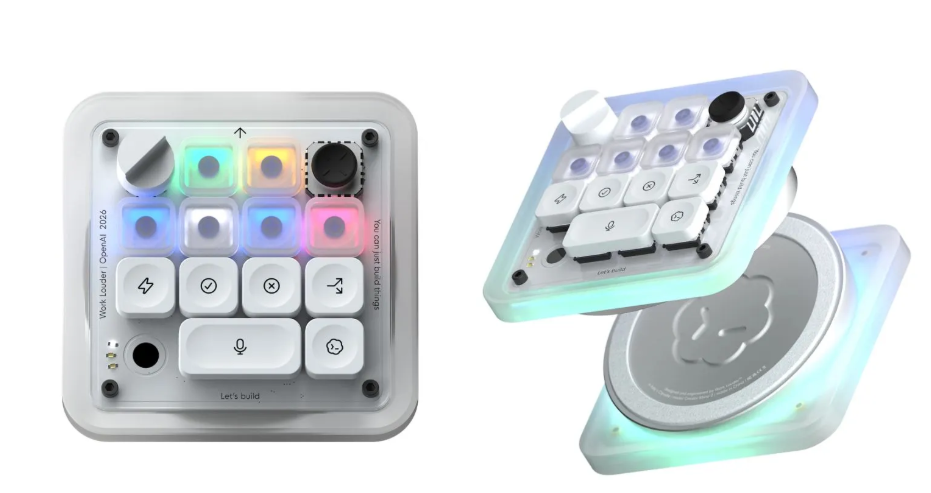
The introduction of Codex Micro highlights this transition by bringing AI interaction into a physical desktop accessory tailored for developers. Rather than replacing existing computers or smartphones, the device is designed to complement existing development environments and streamline interaction with AI-powered coding agents.
The move mirrors a wider industry trend in which AI companies are exploring purpose-built hardware capable of improving productivity, reducing workflow friction, and enabling more seamless interaction with increasingly capable AI systems.
What is Codex Micro?
Codex Micro is a compact programmable mechanical macropad created for users of AI-assisted software development tools.
Unlike a traditional keyboard, it provides dedicated physical controls that allow developers to communicate with AI coding assistants using customizable shortcuts and programmable commands.
The device includes:
- Programmable mechanical shortcut keys
- Live status indicators for AI coding tasks
- A rotary dial for workflow customization
- A joystick for navigation
- Configurable controls for AI-assisted software development
Its design focuses on reducing context switching between coding environments and AI interfaces, allowing developers to execute repetitive actions more efficiently while monitoring AI-generated tasks in real time.
Why AI Hardware Matters
The launch illustrates one of the biggest emerging trends in the technology industry—the convergence of AI software and intelligent hardware.
Modern AI systems are becoming increasingly "agentic," meaning they can independently perform complex tasks such as:
- Writing software code
- Debugging applications
- Reviewing pull requests
- Managing development workflows
- Automating repetitive engineering processes
As these AI agents become more sophisticated, new forms of hardware are expected to provide quicker and more intuitive ways for users to supervise, control, and collaborate with them.
Industry analysts suggest that dedicated AI hardware could become as important to professional workflows as specialized gaming peripherals are for gamers or professional editing consoles are for content creators.
The Growing Importance of AI Coding Assistants
The software development landscape is changing rapidly.
Generative AI has transformed how programmers write, review, and optimize code. Instead of serving only as autocomplete tools, modern AI coding assistants are capable of generating entire software modules, explaining complex algorithms, identifying security vulnerabilities, and assisting with debugging.
This evolution has accelerated demand for tools that simplify interactions with AI throughout the software development lifecycle.
Rather than constantly switching between applications or typing lengthy prompts, developers increasingly benefit from programmable interfaces that allow AI commands to be triggered instantly through physical controls.
This reflects a broader movement toward AI-native development environments where human creativity and machine intelligence work together more efficiently.
A Reflection of the Broader AI Industry Trend
The release of dedicated AI hardware is not an isolated development.
Across the global technology ecosystem, organizations are investing heavily in:
- AI-powered personal computing
- Intelligent developer tools
- Edge AI devices
- Agentic AI systems
- AI-enhanced productivity platforms
- Human-AI interaction technologies
Rather than treating artificial intelligence as standalone software, the industry is increasingly designing complete ecosystems where hardware, software, and cloud-based AI models operate together.
This shift could significantly influence how professionals interact with AI over the coming years.
Potential Benefits for Developers
Purpose-built AI hardware could offer several practical advantages for software professionals, including:
Faster Workflow Execution
Dedicated shortcut controls may reduce repetitive manual interactions during coding sessions.
Better AI Task Monitoring
Visual indicators can help developers monitor AI-generated coding tasks without constantly checking software dashboards.
Improved Productivity
Physical controls enable rapid execution of common development actions, potentially reducing interruptions and improving workflow efficiency.
Enhanced Human-AI Collaboration
As AI agents handle increasingly sophisticated development tasks, specialized hardware may provide a more intuitive way for professionals to supervise, refine, and approve AI-generated work.
What This Means for the Future of AI
The introduction of AI-focused hardware signals an important milestone in the evolution of artificial intelligence.
For several years, AI innovation has primarily been measured by larger models, better reasoning capabilities, and improved natural language understanding.
The next phase may focus equally on improving the human experience of interacting with AI.
Experts anticipate growing investment in AI devices that simplify collaboration between humans and intelligent systems, extending beyond software development into areas such as education, healthcare, enterprise productivity, design, research, and scientific computing.
This shift suggests that the future of AI will be shaped not only by increasingly capable algorithms but also by the physical interfaces through which people engage with them.
Source:indianexpressGPT.