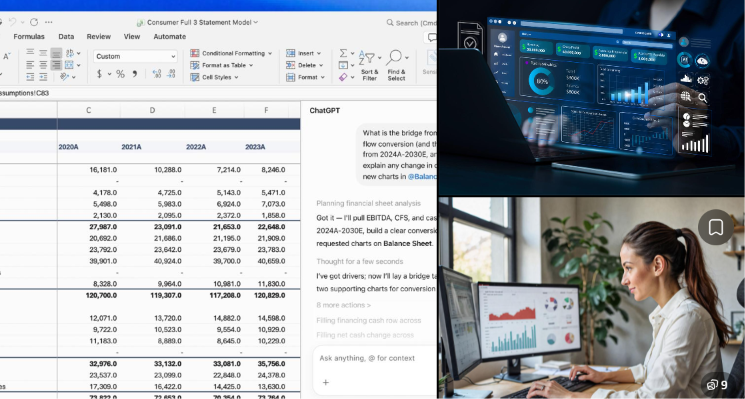
The Growing Role of Artificial Intelligence in Financial Management
Artificial Intelligence is rapidly becoming an important component of modern business operations. From automating administrative tasks to analysing large datasets, AI-powered solutions are helping organisations improve productivity, accuracy and operational efficiency.
The accounting and finance sector, traditionally dependent on extensive documentation, spreadsheets, manual calculations and repetitive data entry, is now witnessing a major technological transformation.
In this evolving landscape, OpenAI has introduced dedicated accounting capabilities within ChatGPT, bringing AI-powered assistance into everyday financial management activities.
The development reflects the growing demand for intelligent financial automation, where businesses can use AI to process financial information, identify inconsistencies and generate structured reports with reduced manual intervention.
Rather than functioning only as a conversational assistant, ChatGPT is increasingly being positioned as a tool that can support practical business workflows.
1. AI-Powered Accounting: Simplifying Everyday Financial Operations
One of the key objectives of the new accounting capabilities is to simplify routine accounting activities that typically require considerable time and effort.
Financial professionals regularly handle invoices, receipts, payment records, transaction entries and supporting documents. Managing these activities manually can become challenging, particularly for organisations dealing with large transaction volumes.
The new AI-powered accounting workflow can assist with:
- Invoice Processing: Preparing draft accounting entries using information extracted from invoices and receipts.
- Transaction Classification: Suggesting appropriate account categories for financial transactions.
- Financial Documentation: Organising information from invoices, receipts and supporting financial records.
- Error Identification: Highlighting unclear information, missing details and potentially incorrect entries.
- Accounting Assistance: Supporting finance teams in preparing structured financial records for further review.
These capabilities can help reduce repetitive administrative work and allow accounting professionals to dedicate more time to activities that require financial expertise and professional judgement.
2. Automated Bank Reconciliation and Transaction Matching
Bank reconciliation is an essential accounting activity that ensures an organisation's financial records are consistent with its bank statements.
Traditionally, finance teams compare bank statements, payment records and general ledger entries to identify differences. This process can become time-consuming when businesses handle thousands of transactions.
AI-powered reconciliation introduces a more streamlined approach.
ChatGPT can assist by bringing together relevant invoices, bank statements and payment records from connected applications, emails and files. It can then help identify matching transactions and highlight discrepancies that require investigation.
Some of the areas where AI can provide assistance include:
- Matching bank transactions with accounting entries.
- Identifying potentially duplicated transactions.
- Highlighting missing payments or financial records.
- Detecting unexplained differences between statements and ledgers.
- Separating possible errors from timing-related differences.
This approach can improve the efficiency of financial reconciliation and make it easier for finance teams to identify discrepancies.
However, final verification remains important, particularly when dealing with financial adjustments and accounting compliance.
3. Smarter Month-End Financial Reporting
Month-end closing and financial reporting are among the most important responsibilities of accounting departments.
Businesses need to consolidate financial information, review expenses, verify transactions and prepare reports that provide an accurate picture of their financial performance.
The new accounting capabilities introduce AI assistance into this process.
ChatGPT can work with existing financial records and reporting templates to help prepare month-end reports, explain significant changes and identify the supporting information behind financial figures.
For example, finance teams can use AI assistance to:
- Prepare structured monthly financial reports.
- Compare current and previous reporting periods.
- Identify significant changes in revenue and expenditure.
- Highlight unusual financial movements.
- Locate supporting records for reported figures.
- Identify missing information and potential inconsistencies.
An important feature is the ability to reuse existing reporting templates and instructions.
This means organisations can establish standard reporting procedures and apply them to new financial records each month, reducing the need to recreate reporting workflows repeatedly.
4. AI-Assisted Auditing and Financial Error Detection
Auditing requires detailed examination of financial transactions, supporting documents and accounting records. Even minor inconsistencies can require additional investigation.
AI can support this process by comparing financial working papers with their underlying supporting documents.
The new accounting workflow can help identify:
- Duplicate accounting entries.
- Missing supporting documentation.
- Differences between financial records.
- Unexplained transaction variations.
- Inconsistencies in calculations and reporting.
- Financial entries that require additional verification.
These capabilities can make preliminary financial reviews more structured and efficient.
However, AI-assisted auditing should not be confused with independent statutory auditing or professional audit certification. The technology assists with document review and identifying potential issues, while auditors and qualified accounting professionals remain responsible for verification, conclusions and compliance decisions.
5. Integration with Existing Accounting and Financial Platforms
A significant development is the ability to connect ChatGPT with existing accounting applications.
Instead of requiring organisations to abandon their current financial systems, the accounting capabilities are designed to work with established software and connected business records.
The platforms identified in the announcement include:
- Intuit QuickBooks
- Xero
- Oracle NetSuite
- BILL
- FreshBooks
- Rillet
- Campfire
These integrations are intended to make financial information more accessible within AI-supported workflows.
For example, an accounting professional may be able to review financial transactions, prepare reconciliation summaries or generate reporting drafts using information available through connected applications.
This approach reflects an important direction in enterprise technology: bringing AI capabilities into existing business processes rather than treating artificial intelligence as an entirely separate system.
The availability and supported functionality of individual integrations may vary depending on the application, subscription plan, workspace permissions and geographical availability.
6. Reusable AI Workflows: Making Monthly Accounting More Efficient
One particularly interesting aspect of the development is the ability to save templates, instructions and review procedures as reusable skills.
Many accounting activities follow a recurring structure. For example, organisations generally follow similar procedures for monthly financial closing, expense classification, reconciliation and reporting.
Previously, teams often had to repeat instructions and recreate the same processes for every reporting cycle.
With reusable AI workflows, organisations can establish standard instructions and apply them to new financial records.
This can help businesses:
- Maintain consistency across monthly reports.
- Standardise financial review procedures.
- Reduce repetitive instructions.
- Improve workflow efficiency.
- Create repeatable accounting processes.
- Support more organised financial documentation.
The broader significance is that AI is moving towards repeatable, task-oriented automation rather than simply responding to individual questions.
7. Data Security, Privacy and Human Oversight
As organisations increasingly connect AI systems with financial applications, data privacy and information security become critical considerations.
Financial records contain confidential business information, transaction histories, customer details and sensitive operational data. Therefore, implementing AI in accounting requires appropriate access controls and governance.
According to OpenAI, information from ChatGPT Business and Enterprise is not used to train its models by default.
The organisation also retains control over connected applications through workspace administration and existing application permissions.
Another important aspect is human oversight.
AI-generated accounting entries, suggested classifications and financial reports are intended to be reviewed before approval. Finance professionals can examine the supporting records, calculations and recommendations before making final decisions.
This reinforces an important principle of responsible AI adoption: artificial intelligence can support financial professionals, but accountability and final decision-making must remain with authorised human experts.
8. The Broader Shift Towards AI-Powered Enterprise Operations
The introduction of AI-powered accounting capabilities represents a broader transformation in enterprise technology.
Artificial Intelligence is increasingly being integrated into specialised business functions, including finance, human resources, data analytics, customer operations and enterprise resource planning.
The development also comes amid increasing competition in the enterprise AI landscape, with other AI providers introducing capabilities for spreadsheet management, data visualisation, collaborative workspaces and business application integrations.
This indicates that the future of AI may not be limited to conversational assistance.
Instead, organisations are moving towards AI-powered business environments where intelligent systems can assist with complete workflows, analyse operational data and support informed decision-making.
For accounting professionals, this shift could create new opportunities to move beyond repetitive data entry towards financial planning, business analysis and strategic advisory responsibilities.
9. What This Means for Accounting and Finance Professionals
The integration of Artificial Intelligence into accounting is likely to influence the skills and responsibilities expected from finance professionals.
As routine activities become increasingly automated, professionals may need to develop a stronger understanding of AI tools, data analytics and digital financial systems.
Some important areas of future skill development include:
- AI Literacy: Understanding how AI systems process financial information and generate recommendations.
- Financial Data Analytics: Using data to identify trends, patterns and business performance indicators.
- Automation Skills: Understanding how repetitive accounting and reporting workflows can be streamlined.
- Digital Accounting Systems: Working with cloud-based accounting platforms and integrated financial applications.
- Data Governance: Understanding data privacy, access controls and responsible AI usage.
- Critical Thinking: Evaluating AI-generated results and identifying errors before financial approval.
For Chartered Accountants, finance executives, auditors and accounting students, these developments highlight the growing importance of combining traditional financial knowledge with emerging digital capabilities.
The future finance professional will increasingly need to understand not only accounting principles but also how technology can improve financial operations.
10. The Road Ahead: From Accounting Automation to Intelligent Financial Management
The introduction of AI-supported accounting workflows signals an important step towards more intelligent financial management.
Businesses are increasingly looking for solutions that can connect financial information, automate repetitive processes and provide meaningful insights without compromising accuracy or accountability.
The next phase of enterprise AI adoption may involve deeper integration between financial systems, intelligent document processing, automated reporting, predictive analytics and AI-powered decision support.
However, successful adoption will depend on several factors, including data quality, regulatory compliance, system integration, cybersecurity and appropriate human supervision.
The objective is not simply to automate accounting tasks but to create more efficient financial operations that allow professionals to focus on analysis, business strategy and value creation.
As AI capabilities continue to evolve, their role in accounting and financial management is expected to become an increasingly important part of the digital transformation journey.
Conclusion
Artificial Intelligence is gradually redefining how organisations approach accounting, financial reporting and business operations.
The latest development in ChatGPT demonstrates how AI can move beyond basic assistance to support specialised financial workflows, including invoice processing, bank reconciliation, month-end reporting and audit preparation.
By combining AI capabilities with existing accounting applications, businesses can explore more efficient ways to manage financial information while maintaining human oversight and professional accountability.
Ultimately, the future of accounting will not be defined by automation alone. It will be shaped by the collaboration between financial expertise, reliable data and intelligent technologies.
Source:economictimes.gpt