Market Overview: Unprecedented Growth in AI-Driven Accounting
The Artificial Intelligence (AI) in Accounting Market is witnessing unprecedented growth, driven by the escalating demand for automation in financial operations and the rise of big data. AI technologies such as machine learning, robotic process automation (RPA), and natural language processing (NLP) are increasingly being adopted by businesses worldwide. These technologies are transforming traditional accounting practices by automating routine tasks, analyzing vast amounts of financial data, and providing real-time insights, leading to significant improvements in accuracy and efficiency.
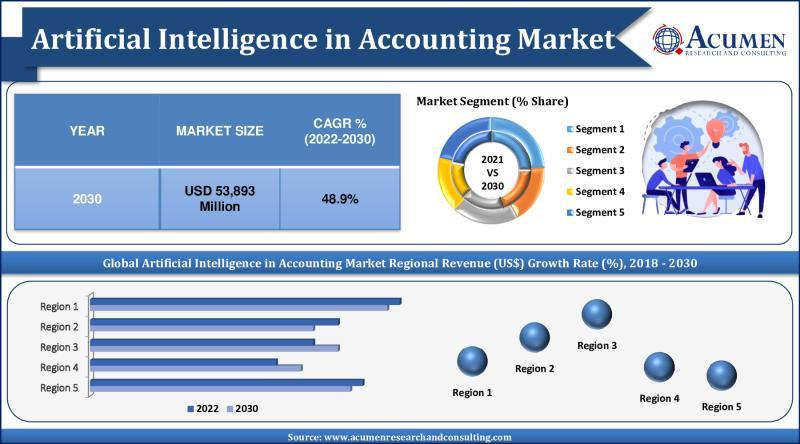
The market, which was valued at USD 1,511 Million in 2021, is projected to soar to USD 53,893 Million by 2030, according to a comprehensive report by Acumen Research and Consulting. This exponential growth underscores the critical role AI is playing in reshaping the accounting industry, enabling businesses to streamline financial processes, reduce human error, and enhance overall operational efficiency.
Key Drivers: Automation, Accuracy, and Real-Time Insights
1. Automation of Routine Accounting Tasks:
AI is revolutionizing the accounting industry by automating repetitive and time-consuming tasks such as data entry, invoice processing, and transaction categorization. This automation is significantly reducing the workload of accounting professionals, allowing them to focus on more strategic, value-added activities that require critical thinking and decision-making.
2. Enhanced Accuracy and Efficiency:
The ability of AI algorithms to analyze vast amounts of financial data with unparalleled speed and accuracy is minimizing the risk of errors in financial statements and reports. This capability is particularly beneficial for large organizations with complex financial structures, where accuracy is paramount.
3. Fraud Detection and Compliance:
AI is emerging as a powerful tool in fraud detection, capable of identifying unusual patterns in financial transactions that may indicate fraudulent activity. Additionally, AI-powered systems are helping organizations stay compliant with ever-evolving financial regulations, reducing the risk of non-compliance and associated penalties.
4. Cost Savings:
The adoption of AI in accounting is leading to significant cost savings for businesses. By automating routine tasks, companies can reduce operational costs, with the initial investment in AI technology being quickly offset by the efficiency gains and reduced human error.
5. Real-Time Financial Insights:
AI-driven analytics are providing businesses with real-time insights into their financial performance, enabling more informed decision-making and better financial planning. This real-time analysis is crucial for businesses looking to stay competitive in a fast-paced, data-driven market.
Market Segmentation: Diverse Applications Across the Industry
The AI in Accounting Market is segmented based on offering, technology, deployment model, application, and enterprise size. These segments highlight the diverse applications of AI across the accounting industry, from automated bookkeeping and fraud management to advanced reporting and invoice classification.
By Offering:
- Solutions: Including software tools and platforms designed to streamline accounting processes.
- Services: Encompassing managed services and professional services that support AI integration and implementation.
By Technology:
- Machine Learning (ML) and Deep Learning: Advanced algorithms that enhance data analysis and decision-making.
- Natural Language Processing (NLP): Technology that enables more intuitive interaction with accounting systems.
By Deployment Model:
- Cloud: AI solutions hosted on cloud platforms, offering scalability and flexibility.
- On-Premise: AI solutions deployed within an organization’s own infrastructure, providing enhanced control over data.
By Application:
- Automated Bookkeeping
- Fraud and Risk Management
- Reporting
- Invoice Classification and Approvals
- Other Applications: Including expense management, auditing, and tax filing.
By Enterprise Size:
- Large Enterprises
- Small and Medium Enterprises (SMEs)
Competitive Landscape: Innovation Driving Growth
The AI in Accounting Market is characterized by intense competition, with key players focusing on innovation, strategic partnerships, and mergers and acquisitions to gain a competitive edge. Leading companies are investing heavily in research and development to introduce advanced AI-powered accounting solutions that cater to the evolving needs of the market. This competitive environment is further intensified by the entry of startups and niche players offering innovative AI solutions tailored to specific accounting challenges.
Technological Advancements: The Future of AI in Accounting
AI technology in accounting is advancing at a rapid pace, with continuous improvements in machine learning algorithms, NLP, and RPA. These advancements are enabling more sophisticated data analysis, automating complex accounting tasks, and enhancing decision-making processes. Moreover, the integration of AI with emerging technologies such as blockchain is offering enhanced security and transparency in financial transactions, further driving the adoption of AI in the accounting industry.
Challenges and Opportunities: Navigating the AI Landscape
While the AI in Accounting Market presents significant growth opportunities, it also faces certain challenges. One of the primary obstacles is the high cost of implementing AI technologies, which can be a barrier for small and medium-sized enterprises. Additionally, there is a growing need for skilled professionals with expertise in both AI and accounting, which poses a significant challenge for businesses looking to leverage AI technologies effectively.
However, these challenges are expected to be mitigated by the increasing availability of affordable AI solutions and the growing focus on training and development programs for accounting professionals. As AI technology continues to evolve, it is likely to drive further innovation in the accounting sector, creating new opportunities for growth and transformation.
Future Outlook: AI as a Cornerstone of Modern Accounting
The future of the Artificial Intelligence in Accounting Market is bright, with AI expected to become an integral part of accounting practices across various industries. The increasing demand for automation, coupled with the need for real-time financial insights, is driving the adoption of AI in accounting, enabling businesses to stay ahead in a competitive market.
As AI technology continues to advance, it will enable more complex and sophisticated financial analysis, allowing businesses to make better-informed decisions. Furthermore, the integration of AI with other emerging technologies such as blockchain and the Internet of Things (IoT) is expected to open up new avenues for growth, solidifying AI’s role as a cornerstone of modern accounting practices.
Source: Open PR | Chat GPT