The Evolution of Artificial Intelligence: From Chatbots to Autonomous Digital Assistants
Artificial intelligence has evolved rapidly over the past decade. Early AI models focused primarily on text generation, language translation, and answering questions. Today, a new wave of advanced generative AI models and AI agents is transforming the technology landscape by moving beyond conversation into action.
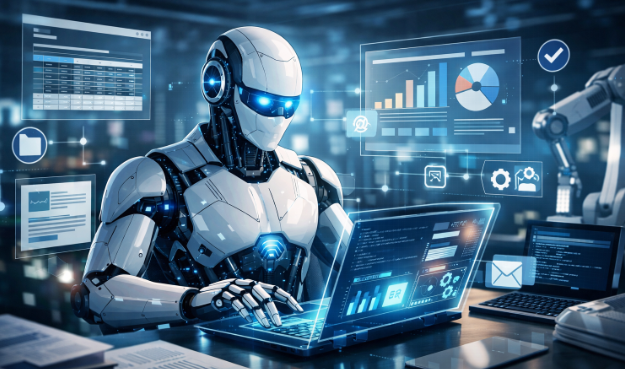
Recent AI advancements demonstrate systems capable of interacting directly with computer interfaces, performing tasks across multiple software applications, and executing complex workflows. These models combine large language models (LLMs), reasoning engines, and software automation capabilities to perform real-world digital work.
Industry observers describe this shift as the rise of “agentic AI”—systems that can perceive information, plan tasks, and take actions autonomously within digital environments.
This represents a fundamental change in how artificial intelligence is used in workplaces, enabling automation not only of repetitive tasks but also of knowledge work traditionally performed by professionals.
AI That Can Operate Computers and Software
One of the most notable breakthroughs in modern AI development is the ability for models to operate computers similarly to human users. Instead of relying solely on APIs or structured data inputs, these systems can interact with graphical user interfaces (GUIs), analyze screenshots, and perform actions such as clicking buttons, typing text, and navigating applications.
Such capabilities enable AI to perform tasks like:
- Managing spreadsheets and financial models
- Creating and editing presentations and documents
- Automating data entry and analysis
- Navigating websites and enterprise tools
- Executing multi-step workflows across multiple applications
Recent frontier AI models have demonstrated strong performance in these tasks, achieving high success rates in benchmarks that measure the ability to operate digital environments and complete professional workflows.
Experts believe this technology could significantly transform how digital work is performed across industries.
The Rise of AI Agents and Autonomous Workflows
The concept of AI agents is gaining momentum in the technology sector. Unlike traditional AI tools that only respond to prompts, AI agents can independently plan and execute tasks based on a goal provided by the user.
For example, an AI agent may be asked to:
- Analyze a dataset in a spreadsheet
- Create a financial report
- Prepare a presentation summarizing insights
- Send the results through digital communication tools
The agent can then coordinate multiple actions—gathering data, analyzing it, generating content, and formatting the output.
Researchers describe agentic AI systems as having several key components:
- Perception: Understanding digital environments and inputs
- Reasoning: Planning actions and solving problems
- Tool use: Interacting with software systems
- Execution: Completing tasks autonomously
These capabilities are expected to redefine workflow automation, business intelligence, and digital productivity in the coming years.
Transforming Workplace Productivity and Knowledge Work
The integration of AI into professional software environments is already reshaping workplace productivity. Advanced models are being used to assist with tasks such as:
- Financial modeling and accounting analysis
- Data visualization and reporting
- Software development and debugging
- Document drafting and editing
- Strategic decision support
Some recent AI models can process extremely large amounts of information—up to one million tokens of context—allowing them to analyze extensive datasets, documents, and complex projects simultaneously.
This capability allows AI systems to handle sophisticated tasks that require understanding large volumes of information, making them increasingly valuable in fields like consulting, finance, engineering, and research.
The Global AI Race and Industry Competition
The development of powerful AI agents is intensifying competition among major technology firms and research labs worldwide. Organizations are racing to build systems that can integrate with productivity tools, enterprise platforms, and digital ecosystems.
Recent releases of advanced AI models show improvements in:
- Reasoning accuracy
- Coding performance
- Spreadsheet and data analysis skills
- Automation across enterprise software
Some reports indicate that newer AI systems reduce errors and false claims significantly compared to earlier models, while also improving efficiency in professional workflows.
As AI capabilities continue to expand, companies and governments are investing heavily in research and infrastructure to remain competitive in the global AI innovation race.
Source:indianexpressGPT.
.