Introduction: A New Direction in Artificial Intelligence
The artificial intelligence industry continues to evolve as technology companies develop increasingly capable models that go beyond traditional conversational interactions. The latest development in this space is the introduction of Gemini 4 Neon, a new AI model announced on November 18, 2026.
The model is designed to deliver advanced reasoning capabilities while maintaining speed and efficiency across demanding professional applications. Its primary focus areas include complex software engineering, enterprise knowledge work, scientific research, analytical problem-solving and multi-step task execution.
An important shift in modern AI development is the transition from systems that simply generate responses to intelligent models that can understand objectives, plan actions, interact with external tools and complete tasks. Gemini 4 Neon reflects this transition by placing greater emphasis on agentic AI capabilities and practical workflow execution.
1. Understanding Gemini 4 Neon and Its Core Capabilities
Gemini 4 Neon is designed to handle complex tasks that require deeper reasoning, contextual understanding and structured execution.
Unlike conventional AI applications that primarily respond to individual prompts, the model is built to support longer workflows involving multiple steps, files, tools and interconnected tasks.
Its core capabilities include:
- Advanced reasoning and problem-solving.
- Complex software development and debugging.
- Enterprise data analysis and spreadsheet modelling.
- Research across large collections of documents.
- Multimodal information processing.
- Automated execution of multi-step workflows.
- Scientific and mathematical analysis.
- AI agent orchestration and tool integration.
The model is positioned between highly advanced reasoning systems and faster execution-focused models, aiming to provide a balance between intelligence, speed and operational efficiency.
This development reflects the growing importance of AI systems that can deliver complete outcomes rather than isolated answers.
2. Advanced Reasoning and Performance Across AI Benchmarks
One of the notable aspects of Gemini 4 Neon is its performance across independent artificial intelligence evaluation frameworks.
According to the published Artificial Analysis Intelligence Index, the model achieved a score of 61 at its highest reasoning setting, placing it third overall in the reported evaluation.
It also demonstrated strong results in several specialised benchmarks covering coding, scientific reasoning, knowledge work and mathematical problem-solving.
Some reported results include:
- Artificial Analysis Intelligence Index: 61
- Vals Index: 70.9%
- AutomationBench: 56.3%
- Terminal-Bench Science: 70.5%
- RiemannBench: 84%
- HLE-Diamond: 71.3%
- Agents' Last Exam: 75.8%
These evaluations indicate that modern AI models are increasingly being assessed on their ability to solve practical problems rather than simply generate fluent text.
However, benchmark results should be interpreted within their respective testing environments. Actual performance can vary depending on the complexity of a task, available tools, instructions and deployment conditions.
3. A Major Focus on AI Agents and Autonomous Workflow Execution
One of the most significant developments in the AI ecosystem is the emergence of agentic artificial intelligence.
Traditional generative AI systems generally operate through a question-and-answer approach. Users provide instructions, and the system generates a response.
Agentic AI introduces another layer of functionality. These systems can break down larger objectives into smaller tasks, determine the required steps, interact with tools, monitor progress and work towards completing an objective.
Gemini 4 Neon has been developed to support these advanced workflows.
Its capabilities are particularly relevant for applications involving:
- Automated software development.
- Multi-step research and information gathering.
- Spreadsheet and document processing.
- Enterprise workflow automation.
- Tool-based task execution.
- Coordinating multiple AI agents.
The model can also function as an orchestrator, directing parallel AI agents to handle different components of a larger assignment.
This approach could help organisations streamline repetitive processes, improve operational efficiency and reduce the manual effort involved in complex digital workflows.
4. Advancements in Software Engineering and AI-Powered Coding
Software engineering is among the major application areas for Gemini 4 Neon.
Modern software development frequently involves more than writing individual lines of code. Developers must understand existing codebases, identify bugs, manage dependencies, modify multiple files and ensure that changes do not affect other components.
Gemini 4 Neon is designed to support these complex development requirements.
Its reported capabilities include:
- Multi-file debugging and code correction.
- Repository-level code understanding.
- Refactoring existing applications.
- Generating production-oriented code.
- Handling complex software engineering instructions.
- Supporting long-running coding sessions.
- Working with development tools and external systems.
The model also demonstrates strong results on coding evaluations, including SWE-sweep and Terminal-Bench.
An important aspect of this development is the increasing role of AI as a software engineering assistant capable of participating in broader development workflows.
Rather than limiting AI assistance to code suggestions, the industry is moving towards systems that can understand project requirements and execute interconnected development tasks.
5. Multimodal AI: Processing Documents, Images, Audio and Video
Another important capability of Gemini 4 Neon is multimodal processing.
Multimodal artificial intelligence refers to systems that can understand and work with different forms of information rather than relying exclusively on text.
The model supports inputs including:
- Text and written instructions.
- Images and visual information.
- Audio files and recordings.
- Video content.
- PDF documents and business reports.
- Spreadsheets and structured information.
One of its key technical features is a unified context window of up to one million tokens.
A large context window allows an AI model to process substantial amounts of information within a single interaction. This can be particularly useful when analysing lengthy reports, reviewing multiple documents, comparing business records or conducting research across different information sources.
For example, an organisation could use multimodal AI to examine a collection of financial reports, extract relevant information from charts, identify important trends and prepare a structured analytical summary.
Such capabilities are increasingly relevant for enterprise AI, business intelligence and knowledge management applications.
6. Applications in Business Intelligence and Data Analytics
The advancement of AI reasoning models is creating new opportunities in business intelligence and data analytics.
Traditional data analysis often requires professionals to collect information from multiple sources, clean datasets, develop reports, identify patterns and prepare dashboards.
Advanced AI systems can increasingly support different stages of this analytical process.
Potential applications include:
Automated Data Analysis: AI can assist in examining large datasets, identifying patterns and highlighting unusual observations.
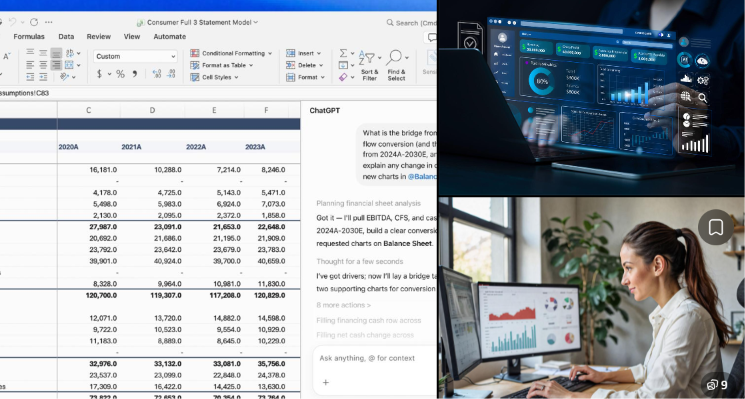
Spreadsheet Intelligence: Advanced models can help interpret complex spreadsheets, generate formulas, analyse relationships and support financial modelling.
Report Generation: AI can transform unstructured information into organised business reports, summaries and analytical documents.
Dashboard Insights: AI-powered analytical workflows can help interpret key performance indicators, identify performance gaps and generate explanations of business trends.
Research and Decision Support: AI can bring together information from multiple documents and sources to support evidence-based business decisions.
The growing integration of AI with business intelligence tools could change how organisations approach reporting, operational analysis and performance monitoring.
However, human review remains important, particularly when dealing with financial information, sensitive business data and decisions that require professional judgement.
7. Supporting Scientific Research and Complex Problem-Solving
Scientific research is another important area where advanced reasoning models are demonstrating potential.
Research activities often involve analysing complex datasets, reviewing technical publications, interpreting mathematical relationships and developing solutions to specialised problems.
Gemini 4 Neon has reported strong performance across scientific and mathematical evaluation benchmarks, including RiemannBench, Terminal-Bench Science and HLE-Diamond.
These results highlight the increasing ability of AI models to support technically demanding tasks.
Potential applications include:
- Mathematical reasoning and problem-solving.
- Scientific literature analysis.
- Technical research assistance.
- Quantitative data interpretation.
- Complex analytical modelling.
- Supporting experimental workflows.
AI should not be considered a replacement for scientific validation or expert judgement. Instead, these capabilities can serve as additional tools to help researchers explore information, test ideas and accelerate parts of the research process.
8. AI-Powered Cybersecurity and Secure Software Development
As AI becomes more deeply integrated into software engineering and enterprise infrastructure, cybersecurity is becoming an increasingly important consideration.
AI-generated code and automated agents can introduce new security challenges if systems are not properly monitored and validated.
Gemini 4 Neon incorporates security-focused capabilities intended to support defensive cybersecurity activities and safer software development.
According to the published model information, the system demonstrates improvements in secure code generation and cybersecurity-related evaluations.
Its intended applications include:
- Identifying software vulnerabilities.
- Supporting secure code generation.
- Assisting with vulnerability analysis.
- Reviewing application security.
- Supporting defensive cybersecurity research.
- Helping developers identify and address potential risks.
The development of security-aware AI models is particularly important as organisations increasingly adopt autonomous systems that interact with code repositories, databases and enterprise applications.
Responsible deployment, access controls, monitoring and human oversight remain essential to reducing potential security risks.
9. The Importance of AI Safety, Reliability and Responsible Deployment
As artificial intelligence systems become more capable, ensuring their safe and reliable operation is becoming a central part of AI development.
Advanced models that can interact with external tools and execute multi-step instructions require additional safeguards.
These include protection against prompt injection, resistance to misuse, improved instruction following and mechanisms for monitoring potentially harmful behaviour.
Gemini 4 Neon builds on the safety and security framework developed for the broader Gemini 4 model family.
However, like other generative AI systems, it may still produce inaccurate information, experience reasoning limitations or misunderstand complex instructions.
This makes responsible AI implementation particularly important.
Organisations adopting advanced AI solutions should consider:
- Human verification of important outputs.
- Data privacy and information security.
- Transparent AI usage policies.
- Continuous performance monitoring.
- Appropriate access permissions.
- Testing before production deployment.
The future of enterprise AI will depend not only on model intelligence but also on reliability, accountability and responsible usage.
10. What Gemini 4 Neon Means for the Future of Enterprise AI
The introduction of Gemini 4 Neon reflects a broader transformation in the artificial intelligence industry.
AI development is gradually moving beyond standalone chatbots towards intelligent systems capable of supporting complete business processes.
For enterprises, this shift could create opportunities across several operational areas, including finance, accounting, software development, research, customer operations and business intelligence.
For developers, advanced reasoning and agentic coding capabilities could help simplify complex software development activities.
For data professionals, multimodal analysis and automated workflow execution could improve how information is processed, interpreted and converted into actionable insights.
For researchers, increasingly capable reasoning systems could provide additional support for technical analysis and scientific exploration.
However, the long-term impact will depend on how effectively these technologies are integrated into real-world environments.
Organisations will need to balance automation with human expertise, establish appropriate governance frameworks and evaluate AI systems based on measurable business outcomes.
Conclusion: Moving Towards More Intelligent and Capable AI Systems
Gemini 4 Neon represents another important development in the evolution of generative artificial intelligence.
Its focus on advanced reasoning, multimodal processing, software engineering, enterprise knowledge work and agentic workflow execution highlights the direction in which modern AI systems are progressing.
The growing emphasis on AI agents suggests that the next phase of artificial intelligence will not be defined solely by how effectively models answer questions, but also by how reliably they can understand objectives, use tools and complete complex tasks.
As organisations continue exploring AI-powered automation, data intelligence and intelligent digital workflows, developments such as Gemini 4 Neon demonstrate the increasing potential of AI to become an integral part of everyday professional and business operations.
The future of artificial intelligence will ultimately depend on combining technological innovation with responsible implementation, human oversight and practical value.
Source:indianexpress.gpt